Finishing a lot of books lately. This one was finished late at night in bed when I should’ve been sleeping. When I realized how close to the end I was though, I had to just keep going through the last 10% of the book.
The whole thing reads like a dream. Not the “it was all a dream” end of a television serial, like an actual dream where you’re simultaneously exploring something new and comfortably thinking about something familiar.
Going too far into the plot gets spoilerific too fast. So let’s just say that a man named Shadow goes on a really crazy road trip. If you’re planning on going on a road trip in America anytime soon, I think this would make an amazing audiobook for your travels.
American Gods (Author’s Preferred Text) on Kindle with avid reader cat, Bagheera.
It feels like an important read. Literature, not fluff. My Kindle edition included discussion questions and I could see a high schooler writing a really great report on it. I’m not into that kind of write-up here on the blog, but you may be glad to know you could.
But I still had a lot of fun reading it. There’s a motif of Shadow mishearing others’ names and it’s fun to catch the real name in spite of his error. The scenes are all great encounters on their own; as much as it is a page-turner it’s also a great pick-up-again. No matter which section you read it will be beautiful to read and another layer of the story.
For a big book that you’ll be proud to have read, this is a good one. I could see myself reading it again and recommend it to you without hesitation.
American Gods by Neil Gaiman, part of my 2017 Reading
My favorite thing about Seth Godin is he knows how to play the changes. The melodies are always a little different, but the harmonies, structure, and tone we expect of his work find the realm where he does best. Make a ruckus, do the real work, and if you’re scared that’s a great compass for where you should go.
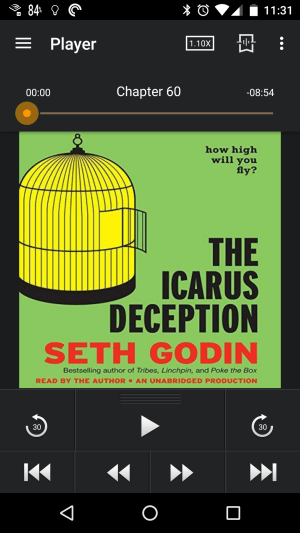
The Icarus Deception fits right into Seth’s repertoire. A full book of content, but chunked up into essays. Once you hit something that resonates, it’s better to put the book down and go act on it instead of staying in reading mode. And it’s a book that will make you want to get something done for sure.
We’ve all been told the story of Icarus flying too close to the sun, but for some reason we’re not all told the other warning: don’t fly too low, or the sea may drag you down. Right now, there is so much opportunity that not enough are aiming to the skies. That’s what Seth wants to solve in this book.
The Icarus Deception by Seth Godin on Audible.
Since Linchpin in 2010, I’ve followed Seth. He caught me right when I decided I wasn’t my best work wouldn’t be as a musician. I needed help to think about my new path, and Linchpin was the start of it. I knew whatever was coming next, it would happen because I made myself ready for it. Trusting on my high school GPA or my bachelor’s degree to get me anywhere was foolish at best, and life-threatening at worst.
Icarus came out two years later, but it was always on my “to read” list instead of “reading.” After Seth’s excellent episode on the Tim Ferriss podcast, I decided to pick up where I left off. When I noticed he read the audiobook himself, that also seemed like a good fit. He’s a speaker and teacher as much as he is an author, and I can’t get enough of hearing him talk.
It’s hard to get through the book, because so many times he’ll say something great that makes you want to go make some art instead. To start that project you’ve been too scared to try. To make your mark at your job. But then it’s also easy to get through the book; it’s refreshing, it’s inspiring, and you want more of it when it’s done.
A good one from Seth, and I’d ask for an encore too.
The Icarus Deception by Seth Godin, part of my 2017 Reading
Mihály Csíkszentmihályi was one the early psychologists to study positive psychology. This book is an explanation of his years of findings in the subject, all put into practical terms for everyone instead of academics.
The premise of the book is that humans are happier overall when they spend more of their time in a state of “flow.” Precisely defining that state is a good portion of the book; for the sake of a brief blog post it can be helpful to think of it with the following visual aid.
The situations that create a state of flow are when the challenge of the situation matches up perfectly with an achievement in our skill. Too easy a challenge on something you’re competent in leads to boredom. A high challenge with no training? Anxiety. High challenges in something you’re very skilled? Flow.
While in flow, our experiences become “autotelic.” We do the thing for the thing’s sake. We master our chess match only because we want to. We climb the mountain because it’s there. Not out of boredom or worry, but because it matches with what we’re skilled to do and it’s a challenge to overcome.
If you’ve not already seen it, you should watch this TED talk before reading the book.
I’ve seen this video more than once and I still found value from the book. But if you watch this and say “meh,” I think you’ll not enjoy it or find it useful.
Once you agree that this flow state can bring about a more systemic joy to your life, the question begins to turn to how you can and can’t control bringing more flow states to your life. Not every job lends itself well to flow, but you may not be so quick to rule yours out. The errands and chores of family life may be boring to you in some ways, but changing your perspective and the system of those actions might help you find flow in commonplace activities.
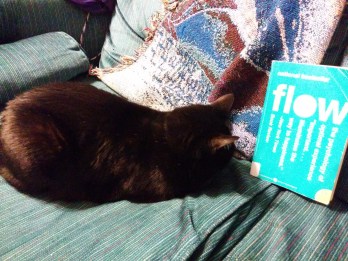
“Flow” in paperback with avid reader cat, Bagheera.
I’m working through a lot of issues right now. Having a young family and managing a career have both tested me a great deal on their own; combined I’m often amazed I’m still standing. But some notions from this book really strike a chord with me. Finding the situations that I can turn into a flow state are worth my while, and I think it an obtainable goal for many hours of my day that currently tend to land in boredom, apathy, or anxiety.
Such systemic changes would lead to good things, I think.
Flow by Mihály Csíkszentmihályi, part of my 2017 Reading
Scalzi is so good at world building. I went into this book cold. All I knew was Scalzi wrote it and Wil Wheaton did the audiobook narration.
Quickly you’re thrown into a near-future world altered by contagious disease and the technology that helps to ease its effects. Millions of people in the near future have “Haden’s Syndrome,” which most often leads to death or lock in.
Technology progresses quickly to help aid people with the disease, who become referred to as “Hadens.” It’s as if having the ailment is becoming another race. Those who are locked in can remotely control “Threeps.” Named after C-3PO from Star Wars, Threeps are machines that allow Hadens to walk around their neighborhoods, go to work, or play sports. All the while, their human body remains in a medical cradle at their home.
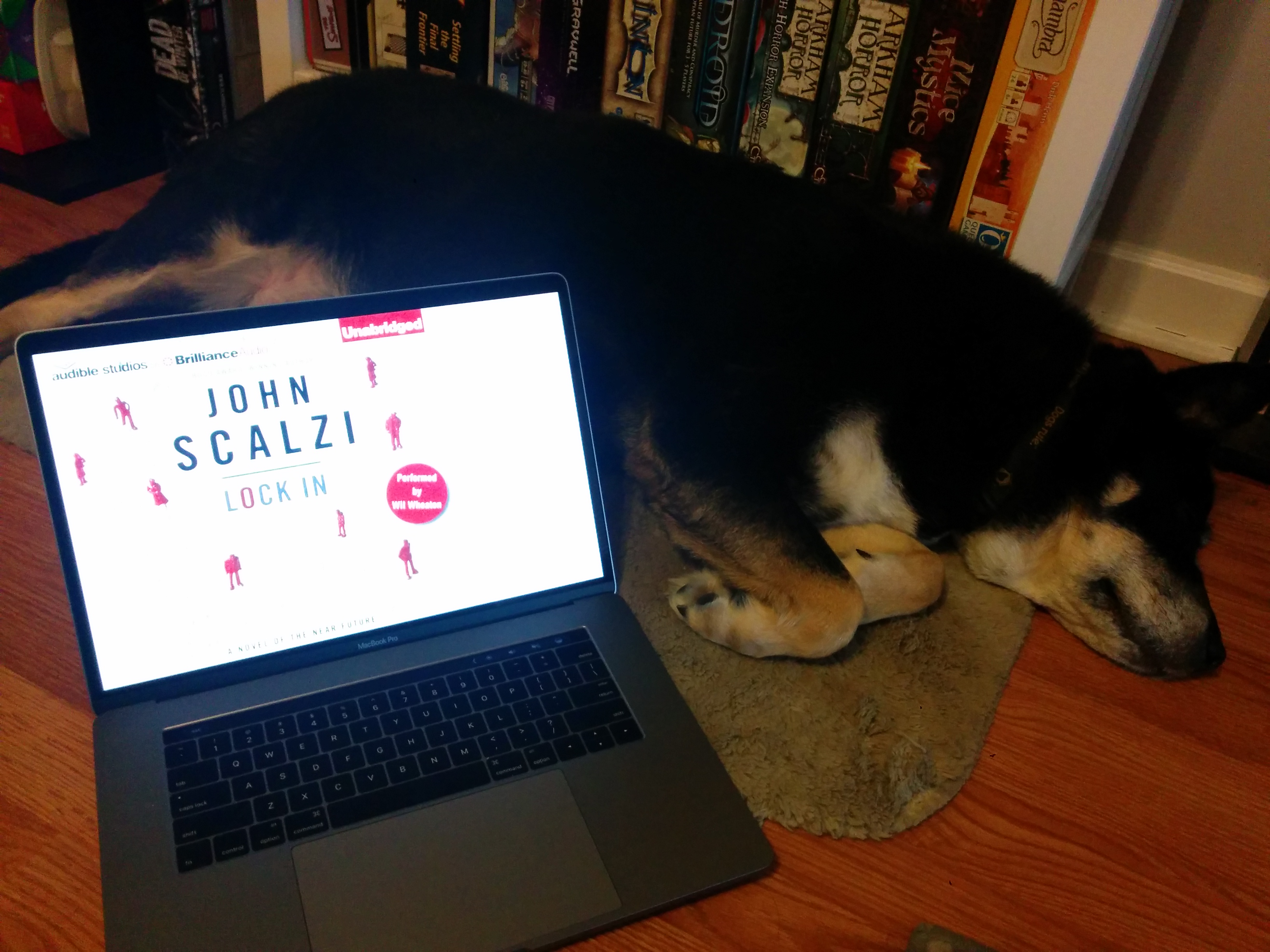
Lock In’s audiobook cover art, with avid listener dog, Nada.
The plot of Lock In is a police procedural, like an episode of Law & Order. Our narrator is a Haden and our story is his first week on the job as an FBI agent. Going too far into the details would certainly spoil,so I’ll leave that be in case you enjoy police procedurals.
It’s not a great story. It falls for the science fiction trap of solving made up problems with made up solutions without connecting enough to today’s humanity. Scalzi performs that connection so well in the Old Man’s War series, it hurts to see it fall short here.
The world though, is superb. I love the political undertones that motivate so many of the characters, providing depth. Threeps and Integrators (spoiler) are interesting enough that I want to read other stories where such a sudden technological change has consequences we’ve not yet predicted. I think it can be done without a technobabble resolution. We can expect at least one more novel in this universe, Head On, and I’ll read it even though Lock In was a letdown to me.
I enjoyed this in Audiobook format via Audible, read by Wil Wheaton. The production was great and I’d recommend that version as well if you want to read this one.
One of my favorite literary devices is an unreliable narrator. The Curious Incident of the Dog in the Night-Time turns that notion on its head by providing a most truthful narrator: a teenage boy with an autism spectrum condition. The narrator, Christopher, is mentally incapable of lying (though he has a talent for noting loopholes) and therefore presents his experiences as wholly accurate accounts. But quickly the reader learns that even such pure truth is filtered by the person’s understanding of the events.
In my case, I was a listener. On our long drive to Arkansas for Thanksgiving, Ber and I got several audiobooks from the library to help things along. This is actually the only one we listened to all the way through as we would normally turn the books off when the baby fell asleep.
Avid listener dog, Nada. The Curious Incident of the Dog in the Night-Time on audiobook.
The interesting narrator holds most of the weight of the book, but that seems enough with the skilled design of its plot. Just enough happens for Christopher to react to that any amount of unexpected twists or secondary storyline would be fluff; a distraction from the character we care about.
One line (bolded below within a larger quote for context) I enjoyed I keep coming back to for nearly a month now:
And Siobhan says people go on holidays to see new things and relax, but it wouldn’t make me relaxed and you can see new things by looking at earth under a microscope or drawing the shape of the solid made when 3 circular rods of equal thickness intersect at right angles. And I think that there are so many things just in one house that it would take years to think about all of them properly. And also, a thing is interesting because of thinking about it and not because of it being new.
As a person who is most happy when left alone to do nothing other than think through whatever is in my head – yeah, I agree.
I also loved this book because it had my five-billionth reference to the Monty Hall problem within like one week. Other ones including Numberphile (via my chronological listen of Hello Internet) and Back to Work. So when the main character explained it so easily I actually knew the answer too. I also love that Haddon has this funny webpage about that bit from the book. It’s like the law of Monty Hall: make something about the Monty Hall problem and everyone will email you to tell you you’re wrong.
It’s a well-executed book with an interesting premise. Would recommend it to anyone in book or audiobook form.
The Curious Incident of the Dog in the Night-Time by Mark Haddon, part of my 2016 Reading
It’s kinda my fault that I didn’t like this book any more than I do. I kinda thought it was going to be like War of Art by Steven Pressfield. But I was kinda dumb. The actual words used to describe the book on all marketing materials make it clear this book is Scalzi’s writing about writers and the writing business. Not about the day-to-day grind of working in solitude (which I could really use some advice on.)
You’re Not Fooling Anyone When You Take Your Laptop to a Coffee Shop on Kindle Cloud Reader. This is how I would’ve read the book on my laptop had I read it on my laptop in a coffee shop.
I guess it says something about my future in publishing that my idea of being successful in that business is roughly equivalent to churning out words everyday. (Laughable at best.)
Even though this ended up not being the book I expected, it was still an enjoyable read. I like Scalzi’s blog, the Whatever, and read all his new stuff there as it comes out. Most of the content in You’re Not Fooling Anyone […] are old posts from that blog when he was still carving out his space as a novelist and primarily working as a non-fiction writer. All his snark is in full force even if it didn’t really motivate me to go and do anything.
And for the record, I’ve been getting some of my best work done in a coffee shop recently.
You’re Not Fooling Anyone When You Take Your Laptop to a Coffee Shop by John Scalzi, part of my 2016 Reading
I’d been meaning to read this book for a while. Friend and then-coworker, who is also named Patrick but is not the author of this book, recommended it to me back in 2012. In April 2016 I bought the damn book when the price dropped for the Kindle copy. In November, I finally got around to reading it and finished it in about two weeks staying up too late most nights. It was a journey, but now that I’ve read the book I can say that Patrick Not-Rothfuss was correct: it is a good book for me.
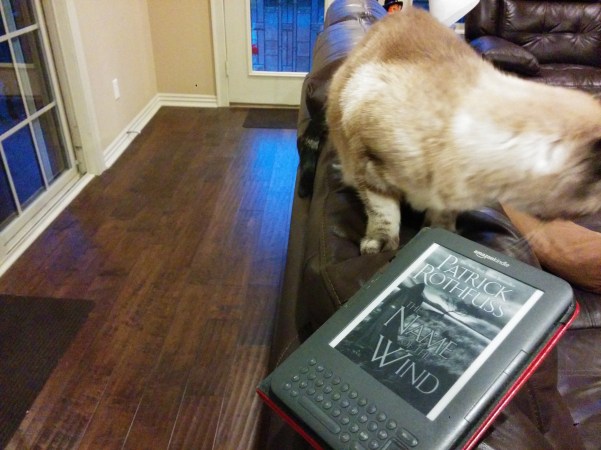
Guest reader cat, Ladybug, who is not as avid as Bagheera. The Name of the Wind on Kindle.
Set in a fantasy world, The Name of the Wind likes to keep its readers guessing as to what toys happen to be at this playground. There’s magic and lore, but there’s also a lot of civilization à la medieval Europe. Paragraphs about medicine, math, and chemistry are just as commonplace as something we’d describe as magical. There’s discussions about the existence or non-existence of rare, mythical creatures or hoaxes.
At its heart, the book is the coming of age for a special young man in Rothfuss’ new fantasy universe. His hero’s work is ahead of him, and he discovers his own world at the same time as the reader, albeit with a head start. Not so different from the young Paul in Dune. We learn about sympathy, Naming, and artificing right along with Kvothe, but can assume from the early pages that he can do all the things a level 1 hero can do here on earth and he’s smarter than the average bear from being raised well by an intrepid troupe of entertainers.
Framed around Kvothe’s young life is an older Kvothe, renowned for his feats and adventures, spinning the tale. That’s how I know there’s better stuff ahead – he told me himself. About the only thing I don’t like about the book is how this frame sets the book as one of a series so early on. It concludes with dialogue that’s nearly a sales pitch for future books. Blegh — it left a bad taste in my mouth.
The story of young Kvothe is enjoyable. But the storytelling is pieced together masterfully. It’s Rothfuss skill that will compel me to the sequels more than the stories yet to be told.
Some “rules” about Rothfuss’ writing that particularly grabbed me:
Associate places and the people in them. It flushes out both the secondary characters and the settings.
Hide foreshadowing within description. Kvothe’s summer before living in Tarbean seemed odd for a while, but it more than made up for itself in later scenes. (No spoilers.)
Create allies and enemies on a spectrum. Not all the good guys are heros. Not every rival is a “big bad” or a peon, more likely somewhere in between.
He stages his scenes efficiently, and there always seems to be a purpose from it. If not immediately, then later. That’s the feeling I’m always hoping to give my own creative endeavors. If one could run a D&D campaign the way this book reads, you’d be one hell of a DM indeed.
The Name of the Wind by Patrick Rothfuss, part of my 2016 Reading
Foolish I was, to believe that I would read this book super quickly. Zoe’s Tale is a parallel story to Scalzi’s previous novel in the Old Man’s War universe, The Last Colony. We go through the experience of the Roanoke colony, but this time from Zoe’s perspective. I thought this meant I could shoot through the story and move on to the next book on my list for the year.
But it was just too good for that. Parallel it is, but the Zoe Boutin-Perry’s experience is wholly separate from her parents’. It’s surprising how little John Perry is involved in this story. The book stands on its own legs and earned my full reading attention, which meant that I took way too long to read it. The library late fees are racking up as I type this post. You, dear average-paced reader instead of a slow-like-me reader, may not have such difficulties because it’s still a typical length and light effort.
Zoe’s Tale in hardcover, with avid reader cat, Bagheera
I must admit that I was also hesitant that it would be too much of the Young Adult genre for me. Teenage relationships don’t really catch my interest, and it is a vital part of the book. But the YA and Sci-Fi are balanced well. At least well enough that I didn’t skip anything.
Most importantly the novel does a couple important things that were missed in The Last Colony.
The ending feels thought-out, full, and true to the narrative.
The colony felt a lot more like a community, less like a group of people being lead by rock star protagonists
From Scalzi’s appendix it sounded like a lot of Zoe’s Tale’s story was developed for The Last Colony and was cut. It covers so many gaps that I wasn’t shocked to learn that. It does make me wonder what The Last Colony could’ve been had it been 150 pages longer and included this material. I’d read it.
Another great episode in a universe I’ve come to love. The remainder of the Old Man’s War books are on my list, but I’m pretty far behind so it may be a bit yet before I read more from Mr. Scalzi.
Zoe’s Tale by John Scalzi, part of my 2016 Reading
After reading Getting Things Done by David Allen, I was excited to get to work. With clarity about my system and tools, I made better Next Steps and forced myself to confront the things I could do and what I needed to defer or delegate.
But on some items, I found myself running in circles. Things big enough that a Next Step would be the planning and thinking about what would make a good next step.
What I needed was project management. The ability to break down big, ambitious tasks with multiple parts into a series of next steps.
GTD falls short on material of how to handle project management. Where David Allen left off, Cesar Abeid picks us up. Reading Project Management For You is like unlocking some hidden bonus chapters of GTD.
I came across this book because I’m lucky enough to call Cesar my friend and colleague. Before our recent team meetup in Austin, Texas, I was making a point to learn more about my fellow teammates. Whenever you become a new Automattician, one of your first tasks is to make a p2 post introducing yourself. Cesar mentioned his book in his intro post, so I added it to my Kindle for one of my plane rides.
Project Management For You on Kindle with avid reader cat, Bagheera
What a great decision! In addition to being the missing sibling to GTD, it was short enough to be read in a few hours on the plane and had some great stories that helped me get to know Cesar.
Cesar and I got to have some good talks about projects and productivity on that meetup. In particular I wanted to hear him speak more on the distinction between projects and operations he makes in the book.
For something to be a project, it has to have an end. You’ve made the thing, you completed the task, and it’s done. Ring the bell – ding! But operations are ongoing. Cesar’s example is that writing a book is a project, but marketing, promoting, and selling it is operations. It’s easy to make the mistake of trying to use project tools to improperly manage operations.
In my work of customer support, I’m in operations. There’s little chance of people not wanting help anytime soon. The chats and emails will keep coming in and we continue to find the best ways to answer them quickly and helpfully.
But Automatticians love projects. We obsess over chances to do a sprint of work once that will pay off multiple times in the future. To the point that sometimes we start to see projects where we should be thinking of how to optimize operations.
The appendix to Cesar’s book helps with this too! Using Agile concepts, you can shift most operations into successive projects. Getting his perspective and advice on this was invaluable for me in person. Unless you have that opportunity yourself, I recommend you check out the book as well as his podcast, PM for the Masses. Here’s an episode with an inteview of David Allen!
Project Management For You by Cesar Abeid, part of my 2016 Reading
I try to avoid being overwhelmed simply by avoiding tasks. Ever invited me to something? I got all cringy and didn’t want to talk about going to it, right? Yeah – I avoid tasks. It’s not a social anxiety thing, it’s a “I have way too much stuff asking for my time to sign up for yet another party/event/whatever” thing.
This should only be one tool in your toolbox. At some point you have to reckon with the responsibilities you do accept.
In the last few years, I’ve gotten better. I embraced the idea of putting thoughts into a calendar and task manager and working off those instead of trying to work off whats in my head.
Accepting that brains are bad at remembering things was easy. I think more clearly when I’m not trying to remember things.
A lot of these ideas I got from blog posts online and two names popped up a lot: David Allen and Merlin Mann. I never totally followed either of them, but the trend was obvious. One day I was in a used bookstore and saw a copy of Getting Things Done by David Allen, so I snagged it.
Getting Things Done in paperback with avid reader cat, Bagheera
And never read it. D’oh.
I never learned the remaining tools I needed to make use of all these lists and calendar appointments with best efficiency. I even complained about this on a post, To-Do Debt.
My colleague Bryan read the post, empathized with me, and wrote a follow-up on his blog: Battling To Do Debt.
He had some great advice, and also mentioned reading GTD, so it went on the reading list instead of just my bookshelf. I finally did it!
The book did commit one of my pet peeves: it spends several paragraphs of its opening chapters making promises about what I’ll learn by reading on. Snore. I already own the book, get to the point.
What follows after that is a document you immediately want to read again, as you follow its advice. It’s odd because once you’re about halfway through, every time you pick up the book you ask yourself, “should I read more or spend some time doing what I’ve already learned from it?” The only answer I have is “plan to read it more than once.” Then it doesn’t matter how many times you put it down to get stuff done.
Thankfully I had already done some of the hard work. I’m not in overwhelm mode and my mind is mostly dumped. But there’s more efficiency to be had,for sure.
For the Olympic weightlifter, the title is won with efficiency not just strength. The same is true for work. Efficiency with your tools and planning can push you much further than just worker harder for more hours.
The biggest new habits GTD has convinced me of is to focus on Next Steps and to hold Weekly Reviews. My biggest pitfall that lead to “to do debt” (as I called it) was trying to use my to-do list as a habit changer. Really I should use thought-out next steps as the habit changer and not be scared to leave some things on a Someday/Maybe list. So long as a I have my Weekly Review, the Somedays will be seen and maybe allowed to be a project with a Next Step.
I even convinced Ber to do a portion of my Weekly Review with me to make sure we’re on the same wavelength.
So I guess what I’m saying is: it’s a good book if you’re ready to work.
Getting Things Done by David Allen, part of my 2016 Reading




 Alex "Gus" Gustafson