• This weekend’s Kentucky Open will be my first chess tournament since the Cincinnati Open in April. As of this writing 116 players are registered for both the Open and Scholastic sections, a new record number of participants in the KY Open previously set in 2007.

    Taking a look at the field comes with a pretty big asterisk: the registration form was just confusing enough I bet a number of players signed up for scholastic or open incorrectly. They offered a discounted entry fee for scholastic players and players under 1200 rating. To make this happen, the section select field online had three options:

    • a. “Open”
    • b. “Scholastic Open”
    • c. “Scholastic and Players Less 1200.”

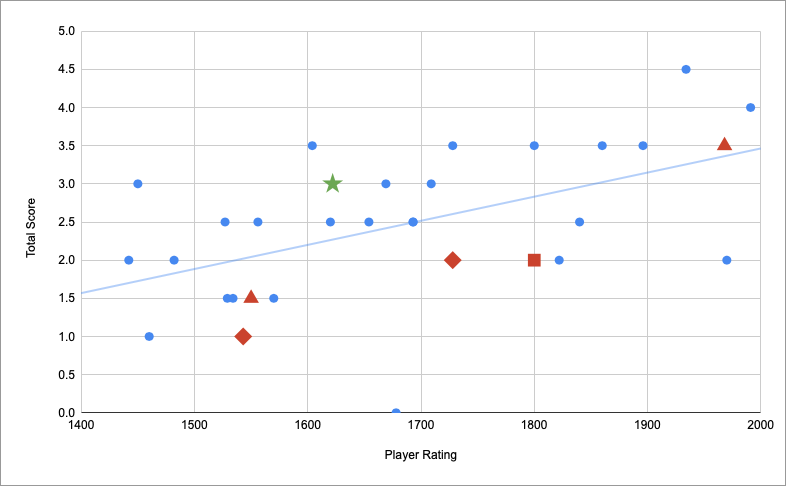
    Option C means you want to play in the Open section, but qualify for the discounted fee. Option B is for Scholastic players only, playing in their own separate section from the Open. If you hovered your mouse over the options there was clarifying text… but how many people besides me do that kind of thing? Anyway, I just bet there’ll be some section switch-ups on the day. But let’s look at the scatter plot for the Open section anyway.

    I’m in the 68th percentile of the field (the green star) with a rating of 1652. Assuming they use a typical swiss system pairing my opponent in the first round would have a rating of 754. With five rounds in the tournament my expected result is about 3.5 points, so to gain rating I’d likely need to keep to only one loss and/or end up with a challenging set of matchups. Some pressure comes with being in the upper half of a field with large variance.

    There are class prizes as well as overall prizes. I’m seeded 8th among the 9 players in the 1600 – 1800 class. Since pairings are across the whole open section, not within the class, who knows which of us will get easier or harder matchups? So winning a class prize isn’t impossible. The overall prizes are certainly out of my reach – there’s a 2600 GM clearly the favorite for 1st and five more players above 2000 vying for 2nd. There is also a $100 prize for “best upset” which is fun to dream of.

    Goals

    My primary goal for the event is to enjoy my new repertoire for the white pieces. I’ve been playing an aggressive 1. e4 repertoire for over a year, and in May I conceded that the opening choices were just too advanced for me. Only a couple of times was I fully losing out of the opening, but many times I was better and then had no grasp of how to proceed in a better middlegame. I need positions I can understand more intuitively. I studied a new course on Chessable that I’ve found much easier to learn and this will be my first time playing with it over the board. I’m committing to playing this white repertoire every game I can.

    My secondary goal is to have at least one good post-mortem. It can be difficult to make one happen when there’s not much time between rounds, but it might be my favorite thing about tournament chess. The act of opponents immediately turning into fellow travelers is a beautiful thing. I’m not as familiar with our venue this year and not sure if there will even be a skittles room (or just a hallway) but I’m hopeful some analysis can happen. My daughter is playing too, so that’s one more hurdle for this goal but I think it can be managed.

    Prep

    For the last few weeks I’ve met up in-person with a training partner on Saturday evenings and we’ve had a blast. We’d start the session with a 25+10 game, then continue on with some tactics, “guess the move,” endgame lessons from a book, or reviewing each others’ games for a total of 4 to 5 hours each session. We’d play at a local brewery so having a couple drinks in the process made it laid back and very fun. Hell, even without the tournament the prep has been a blast.

    Final Thoughts

    It’s worth confronting that I have some superstitious worry about the tournament. The KY Open was my worst performance of 2024 (in my view, maybe not statistically) and I worry this time of year is just not great for me. My online play has also been lacking ever since my April tournament where I felt dialed in.

    So on the sport psychology side, I’m not feeling at my best. But I’ve decided not to combat that with too many hours of cramming or creating expectations for myself. I’m going to face it head on, have a great time, learn from my games, and see what happens. Like the gardener that “plants some seeds, see what grows” we’ll just live with the consequences without much thought about it.

    It’s chess and it’s a privilege to play.

    Good luck, have fun.
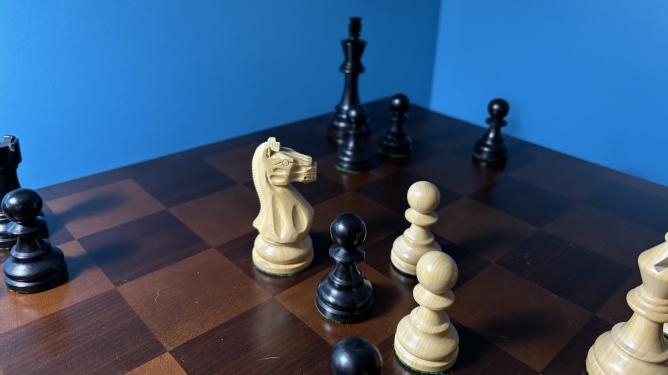
  • Chess middlegames are hard to codify. When I was six years old I could’ve rattled off some rules for the opening: control the center, develop your pieces, castle early. But if I had the misfortune to play someone who also could play a reasonable opening, we ended up in a middlegame where there were no more rules, only choices. One strategy has begun to hit me over the head more often when I find myself with choices: find your knight a good square.

    Read the full post at https://www.chess.com/blog/alexjgustafson/move-your-knight-up-the-career-ladder

  • These will by my main (Chess Dojo approved!) efforts:

    1. Annotating games from Cincinnati Open (and some other non-tournament classical time control games)
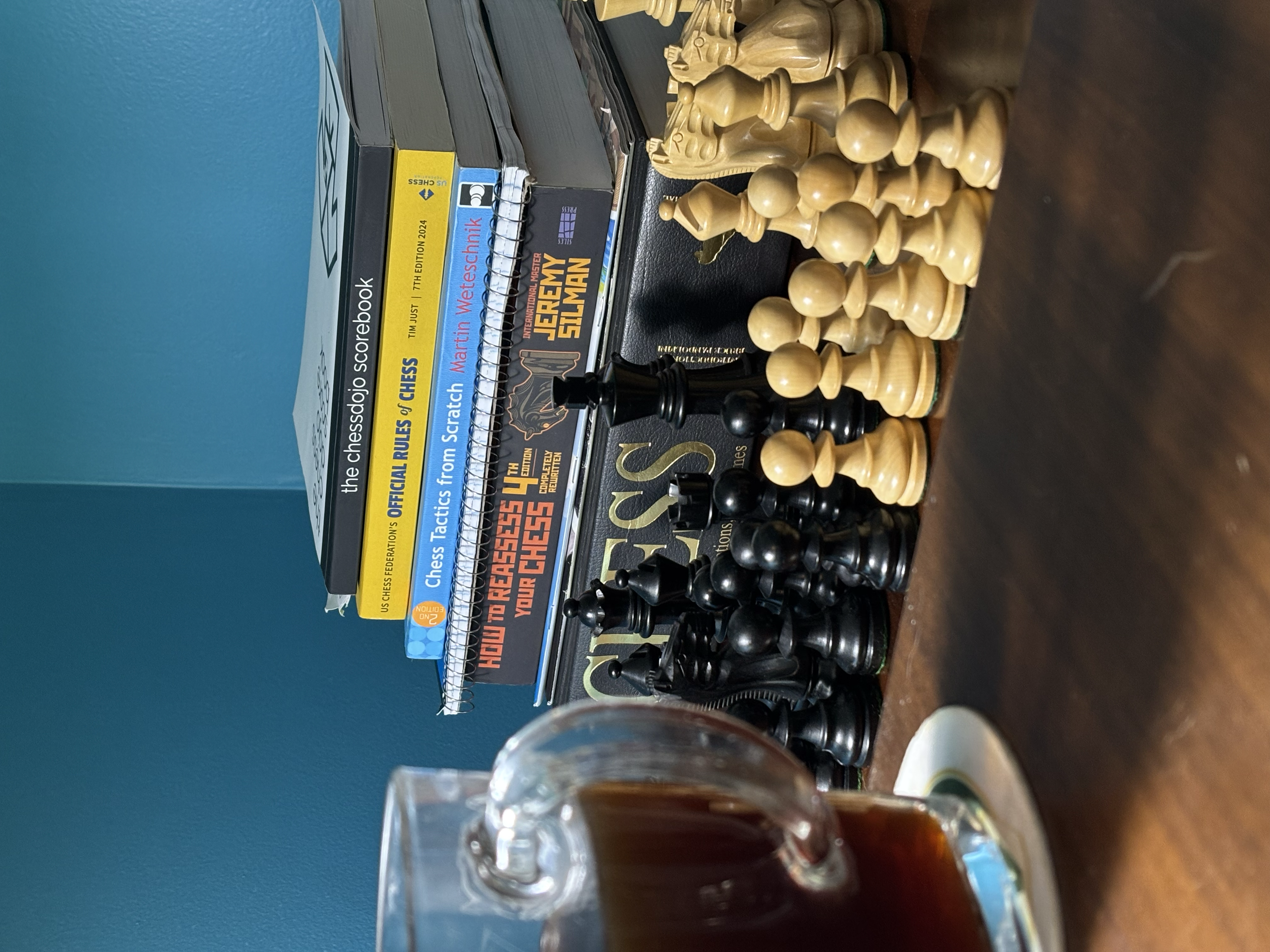
    2. How to Reassess Your Chess by Jeremy Silman
    3. Chess Tactics from Scratch by Martin Weteschnik
    4. Polgar mate-in-2s

    Less important studying, but will be around:

    • Chess Life magazines as they come
    • USCF Official Rules of Chess (I recently became a Club TD and want to keep reviewing to get the book in my bones before next fall’s scholastic season where I can assist.)
    • Drinking coffee and staring at the beautiful chess table and pieces I got for Christmas
    ,
  • This weekend’s chess tournament was a success. Travel to and from Cincinnati was smooth and uneventful. The event was well-run and all but the last round started on time. I was fortunate enough to meet up with a fellow Chess Dojo member, Carl, and we reviewed a couple games together and got to talk between rounds. We ended up sitting at adjacent boards in the last round so we caught a little of each other’s final game.

    I would enjoy playing in this tournament again!

    Games

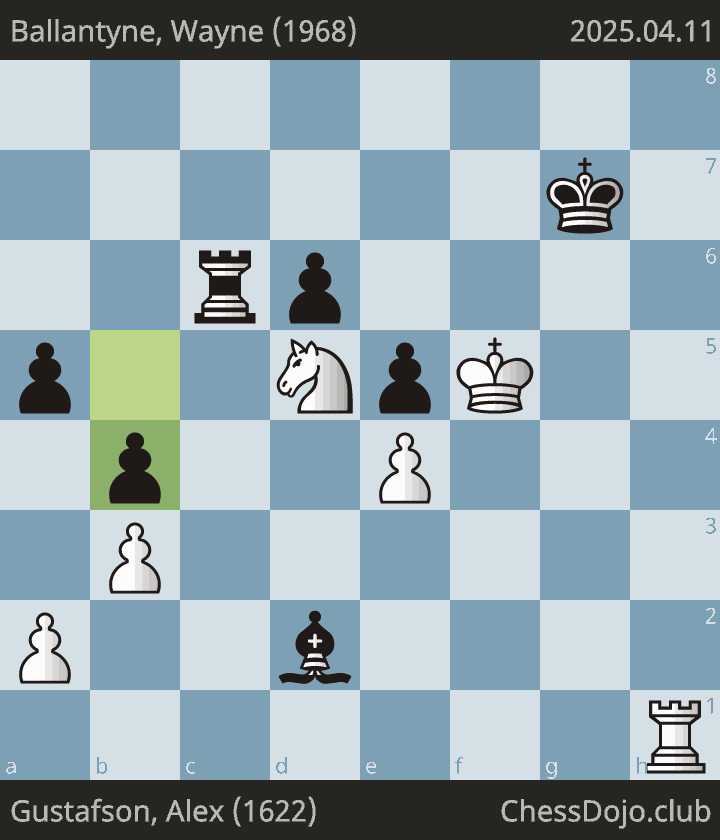
    Game one on Friday night was sufficient for me to happy, really. I was paired with the third-highest rated player in the field and confidently held my own the whole game. In our endgame I felt I had a winning position going into the final time control (shown below.) While I was a little bummed not to find a strategy to convert, I kept enough control to secure the draw once I decided I could not force the win.

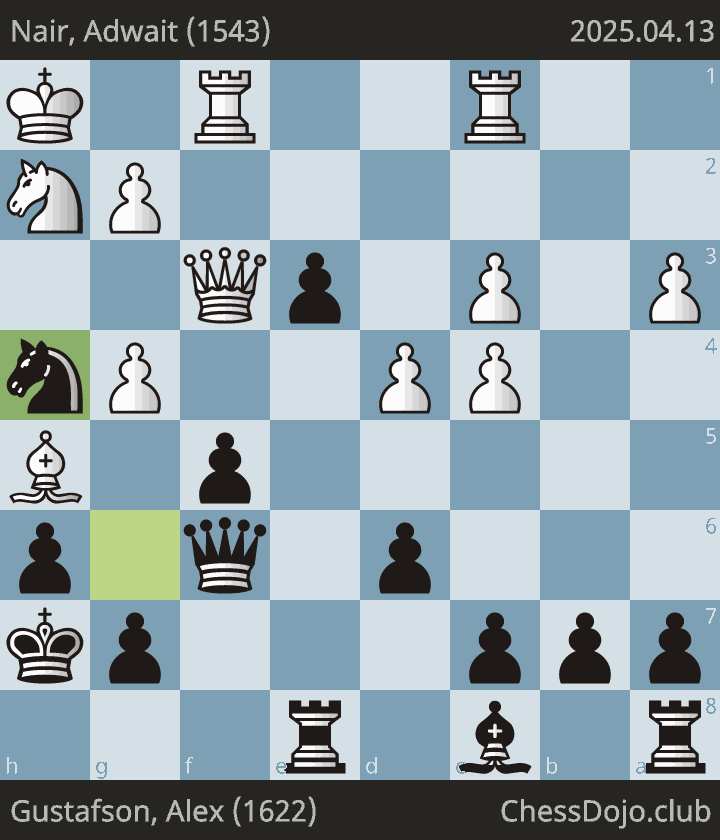
    White to play. I’ll be studying this one for quite some time to come.

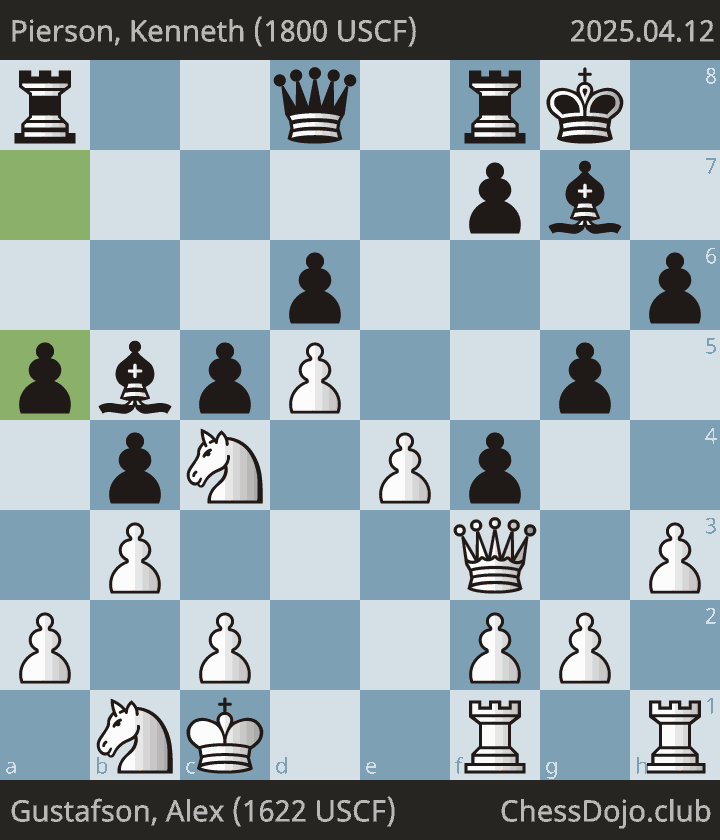
    Saturday morning I had a tough loss, but an excellent post-mortem with my opponent immediately after. He was rated over 2100 in the 1980s, but with age now plays at his floor of 1800.

    White finds himself in an unpleasant position.

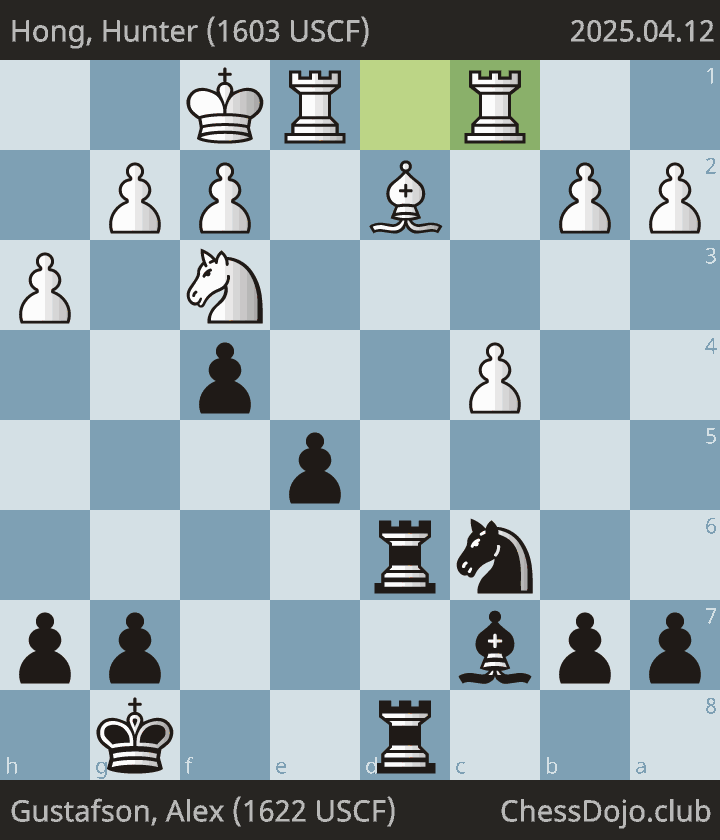
    Saturday evening was an un-inspiring draw against a kid who chose not to think for longer than 2 minutes on any one move. Most tournaments I’m going to play one or two of these types, and it’s frustrating when they will still have great results on intuition alone. The game was draw-ish almost the whole way through, but I missed a significant opportunity to trade a rook for two pieces, with a winning position. Ultimately, the draw was my own fault.

    White just played 23. Rc1? leaving the bishop
    under-defended. Here I played 23 …a5? missing the game-changing 23 …Rxd2!

    On Sunday I earned two wins from aggressive play early on that never let up after gaining an advantage.

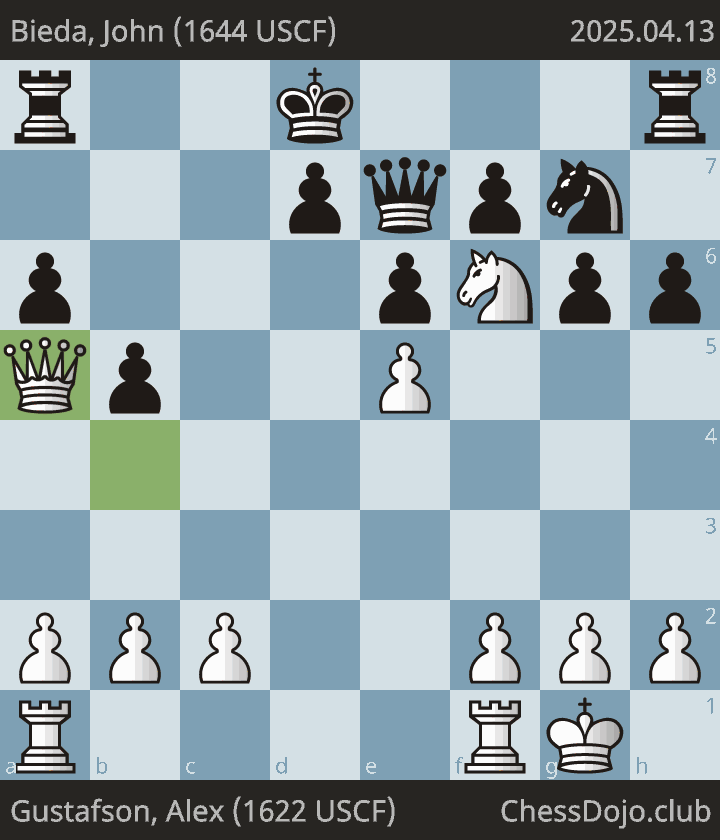
    Already up two pawns, 24…Nxh4! kicks off an unstoppable kingside attack.
    White’s development advantage in the opening transitions to incredible pressure. White has plenty of time to bring in the rooks while black struggles to activate any of his pieces.

    Results

    My goal of time management was absolutely achieved. I made use of the second time control on four of the five games but was into the endgame each time, not having to rush a complicated middlegame which has historically been my problem. This long time control was absolutely my preferred speed of play. Game one went nearly 5 hours!

    The weekend also perfectly facilitated my broad goal of focus. I had a blast the whole time. I’m very appreciative my family let me head off on my own for a few days, and I know they were supporting me from home, watching the SwissSys pairings go up and catching up with between rounds. My daughter had a great tournament herself in Frankfort on Saturday for the KY Women and Girls Open, so everyone was in good spirits.

    I outperformed my expectation for this field, being seeded 19th of 32 and ending in a four-way tie for 9th place at 3 points. Final standings are available on the event’s SwissSys page. My unofficial USCF rating adjustment is a 30-point gain, from 1622 to 1652. This is still shy of the 1675 I need to graduate from my Chess Dojo cohort, but a similar performance at my next tournament would get me across that line.

    The green star is my data point. Red data points indicate my opponents: diamonds for my wins, triangles for my draws, and square for my loss.
  • I’m two days out from my first chess tournament of 2025, the Cincinnati Open. We’ve been saving up all chess-related money since December so that I can play the three-day schedule with two hotel nights. I identified this tournament as a good one where I could have a weekend away without the travel expenses being too extravagant, and would be my first-ever opportunity to earn a FIDE rating.

    As of this writing, I’m in the 40th percentile of my section. Players can register or withdraw all the way up until Saturday morning. This is the “FIDE Class” section restricted to 1400-2000 rated players.

    Since I’m just under the median of the section, I will likely play someone rated 1900+ in the first round. Naturally, I have no result expectations in that first round. Instead I’ll mentally prepare to give it my best, quickly wind down afterwards to get a good night’s sleep, and start fresh again on Saturday morning. Games against much higher rated players often provide good opportunities for analyzing later.

    Goals

    My primary goal for the tournament is regarding time management. I’ve basically given up playing in tournaments with time controls less than G60 because I never have enough time in the endgame. That said, even with longer time controls I still have a tendency not to leave enough time for the endgame. I’ve been improving this winter during my online training games and I hope it pays off here.

    We’ll be playing a time control of 40/90, SD/30;+30. My goal is that for any equal endgame, I can use the entire second time control. Since the longest games I’ve played in the last year were 90+30 and no second time control, I have a great chance of succeeding at this goal with my typical play.

    As for tournment outcomes, I’d love to finish in the top 10. To do so would require one of my best tournament performance scores to date (probably the best.) That performance would likely be enough to improve my USCF rating past 1675, allowing me to graduate to the next cohort in the Chess Dojo Training Program. But really the only outcome I’d find disappointing is a score of 0.0.

    On a broader level, my biggest goal is to enjoy a long weekend of intense focus. This is the kind of environment I want my life optimized for, and I rarely get to experience. I’m very appreciative of my family for allowing me to use time and resources for something so selfish, and I want to make the most of it.

    Prep

    My streak has continued since my accidental 100 days of chess, so I’m now at 128 days straight of studying/playing everyday. For the last month, my focus took a turn mostly to openings. There were many lines in both my white and black repertoires that I simply hadn’t explored so that needed to happen. I still didn’t get as far as I’d have liked, but c’est la vie. In the last week we’ve changed again: opening study is now just Chessable reviews daily and study time is tactics and endgames. That’s where we’ll stay today and tomorrow as well, then only a small tactics session to get warm on Friday.

    Follow Along

    If you’d like to see my results throughout the weekend, the tournament is using SwissSys for all charts and pairings. Visit that page here (https://swisssys.com/section_selector.php?t_id=4696&tournament=2025%20Cincinnati%20Open)

  • In online chess communities there’s a common challenge to do “100 days of chess.” Usually it’s some program of tactics, studying a book, and some number of games that the player dreams up. The intent is always to work that program every day of 100 days straight.

    It wasn’t my intention to do the challenge but today I realized… I hit 100 days of chess.

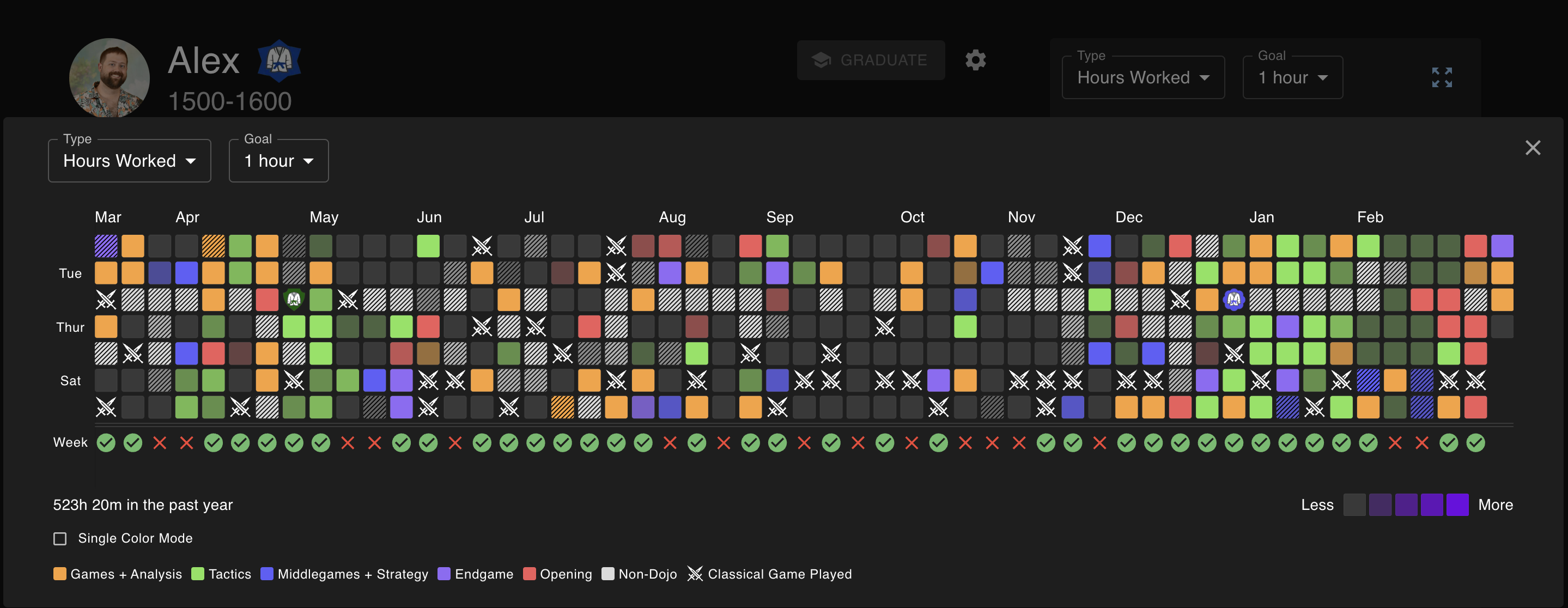
    The last day I haven’t done some amount of chess was December 2nd, 2024. Several of those days were only 10 to 15 minutes doing tactics, but it was something every day. Some of those days were tournaments or single games that lasted hours and hours. Counting all the games, all the studying, all the tactics, all the time at chess club with Grace – I spent 10,005 minutes. That’s an average of 1 hours 40 minutes a day.

    My activity heat map on the ChessDojo Training Program.

    There wasn’t a point where I decided to start going on a streak necessarily, but there’s definitely a tool that made it more obvious I was on one. I use ChessDojo to guide my training and track my progress and at some point they added a “heat map” feature to your profile. The first place I saw a diagram like this was on Github, and it’s a good fit here too. It was pretty motivating to see at a glance when I’m putting the work in and what kind of work I’m doing.

    I don’t intend for the streak to go on forever. I’m playing in a tournament in April and will need a break after that. But since I never was trying for a streak to begin with, that’s not a demotivating thought at all. A better challenge anyway might be like “300 days a year of chess.”

  • Sales is difficult.

    Multiple times I’ve started projects where success ended up resting almost entirely on sales. Each time I was confident that the rest of my marketing mix would be sufficient to overcome any selling problems. Each time I was wrong. Sometimes I’ve even had the hubris to think I’m good at sales despite evidence to the contrary.

    What I’m starting to understand is that when I face difficult tasks my instinct is to start blocking out the world. I want my desk and calendar cleared so I can focus and think. I want hours in a row with no other expectations or distractions. And definitely no phone calls or messaging with anyone. This has served me well in coding and planning but in sales is an absolute wreck. It’s a social sport and persuasion happens emotionally. Emotional connections are not improved by going into a cave of productivity.

    So there are two parts to the lesson. One, I need to acknowledge this instinct. When I feel the need to seclude, first question if it’s really the appropriate solution. The times where seclusion is right my instinct will already carry me there. Two, I need to accept my shortcomings. If sales is the main driver of success on a project, I should be a supporting character and find the right person to lead. It could mean avoiding some opportunities altogether, and that’s okay.

  • Five years ago, I still struggled with barbell math. I knew nothing about making a training program, but I appreciated being told the underlying ideas when I was given one. Most of my effort was still about just showing up. I was still coming to grips with the fact that even if I trained well, I had missed the best time of my life for training. I still had no idea why you couldn’t outwork a poor diet.

    But five years ago I finally let coaches tell me what to do instead of flailing on my own or arguing what they had to say.

    I’m running my own little gym now. And I want to serve others the way those coaches served me. I’m not a gifted athlete, but that serves me well with a lot of people. Because all the problems I’ve had to solve and all the mistakes I made and all the little victories I’ve won… it’s normal people stuff. It’s the stuff for folks that groan getting out of the recliner. For folks that walk into the gym and are scared of everything but the treadmills.

    I couldn’t help you lose your water to get stage ready at a bodybuilding competition. But I know from experience plenty of tools to help an obese person lose 50+ pounds.

    I couldn’t guarantee you an athletic scholarship at a D1 school. But I know from experience how to help a sedentary person enjoy moving their body.

    It’s been tough gaining members at the gym. But at the core of the work I put in is a memory of who I was and how much I needed a coach. So I’ll keep trying my best to help. If you’d like to find out more, check out Gus’s Barbell Club at gus.coach.

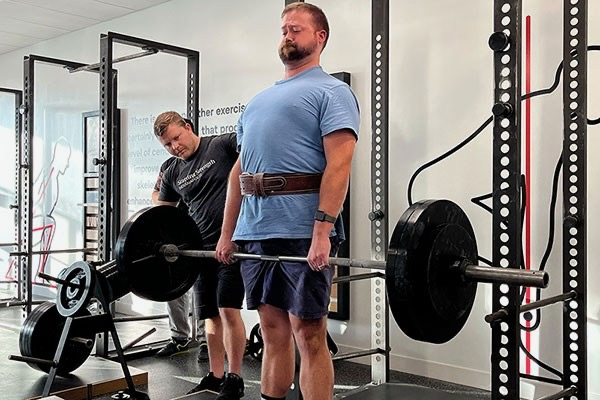
  • Had the pleasure of attending a Squat and Deadlift seminar at Starting Strength Indianapolis, and a photo from that seminar was used for a recent article on StartingStrength.com.

    Strength Training Will Force You to Fix (Almost) Everything

  • Unlike 2020 I didn’t have any goals around reading, but I did try to keep books around as much as possible. I listened to some audiobooks while running, always had a book in progress on my phone, and since we take our daughter to the library all the time I’d make sure to pick a book for myself each time too. In the end I read more than 2020, so there ya go: habits beat goals again.

    Young Guns: Obsession, Overwatch, and the Future of Gaming by Austin Moorhead

    Probably says a lot about me that I’d read a book about video games just as soon as play one. To be honest though I did play a lot more video games in 2021 too.

    The Three-Body Problem by Cixin Liu

    Real trip of a story. Tough to read through translation at times but loved thinking through it. First of a trilogy so will plan to hit the 2nd book in 2022.

    Solutions and Other Problems by Allie Brosh

    So so funny. Hilarious even. Get a taste here: http://hyperboleandahalf.blogspot.com/2020/09/richard.html

    The Power of Habit by Charles Duhigg

    Another one of these books that gets referenced a lot in other books I read… fits in with Talent is Overrated, Triggers, Atomic Habits… Worth the read. Since I take in so many books, podcasts, etc on this topic I felt like I had already heard all the ideas and advice it provided but I could see where for some people this would be the book that clicks for a better life.

    Lives of the Stoics by Ryan Holiday

    A survey history of stoicism, told as the biographies of the school’s leaders and best-known practitioners. Really well put together: enough narrative to keep it from feeling dry, and plenty of great “Holiday-isms” like we’re used to from his previous books.

    The Collapsing Empire by John Scalzi

    Book 1 of the trilogy. Listened on Audible while training for half marathon. I bought this when it was on sale at some point and never got around to listening, but then the other two books came out and I had a half marathon to train for so figured I’d listen to all three while I was running. It was a good idea because I enjoyed the story (over-the-top space opera) so I told myself I was only allowed to listen to it while running. Made me run, made the running fun, which made a good feedback loop.

    The Consuming Fire by John Scalzi

    Book 2 of the trilogy. Listened on Audible while training for half marathon.

    The Last Emperox by John Scalzi

    Book 3 of the trilogy. Listened on Audible while training for half marathon. My favorite one of the three.

    The Call of the Wild by Jack London

    First read this in junior high and it sticks in my mind as the first book I actually tried to interpret past the story itself. Where it’s obviously not just about a dog, even if you like the story about the dog. I liked it even better this time and felt it timely to my season of life.

    Love People, Use Things by Joshua Fields Millburn and Ryan Nicodemus

    The Minimalists are guilty-pleasure self-help and I’m here for it.

    The Inner Game of Tennis by W. Timothy Galloway

    I started playing tennis this fall for the first time in decades. Read this book three times and really helped me enjoy taking up the game.

    Beyond Laravel: An Entrepreneur’s Guide to Building Effective Software by Michael Akopov

    Quick read for the people who’d want it.

    12 Rules for Life by Jordan Peterson

    Enough people talked about Jordan Peterson I’d figured I’d at least read his book. I disagree with him on a lot but respect his willingness to think through difficult topics and stand by his own opinions. But by the end I was pretty sick of him; the kind of person I’d meet at a party, recall it as good conversation, then hope I never run into again.

    The Boys in the Boat by Daniel James Brown

    Great story to end my year. I use a rowing machine a lot, and while I’d never try to compare myself with Olympians it was helpful to remember some of my more painful rows while taking in this story. Makes me thankful for my loving upbringing.

    Honorable mentions

    These books were either partially read, or perhaps are the kind of book you don’t read all the way through… but were considered enough to be worth mentioning.

    • A Journey Through Philosophy in 101 Anecdotes by Nicholas Rescher
    • How to Solve It by George Pólya
    • Walkaway by Cory Doctorow
    • How to Live by Derek Sivers
    • Rebuilding Milo by Aaron Horschig

    Comics

    I read too many comic books to list but wanted to mention a few of my favorites this year: