Category: Books

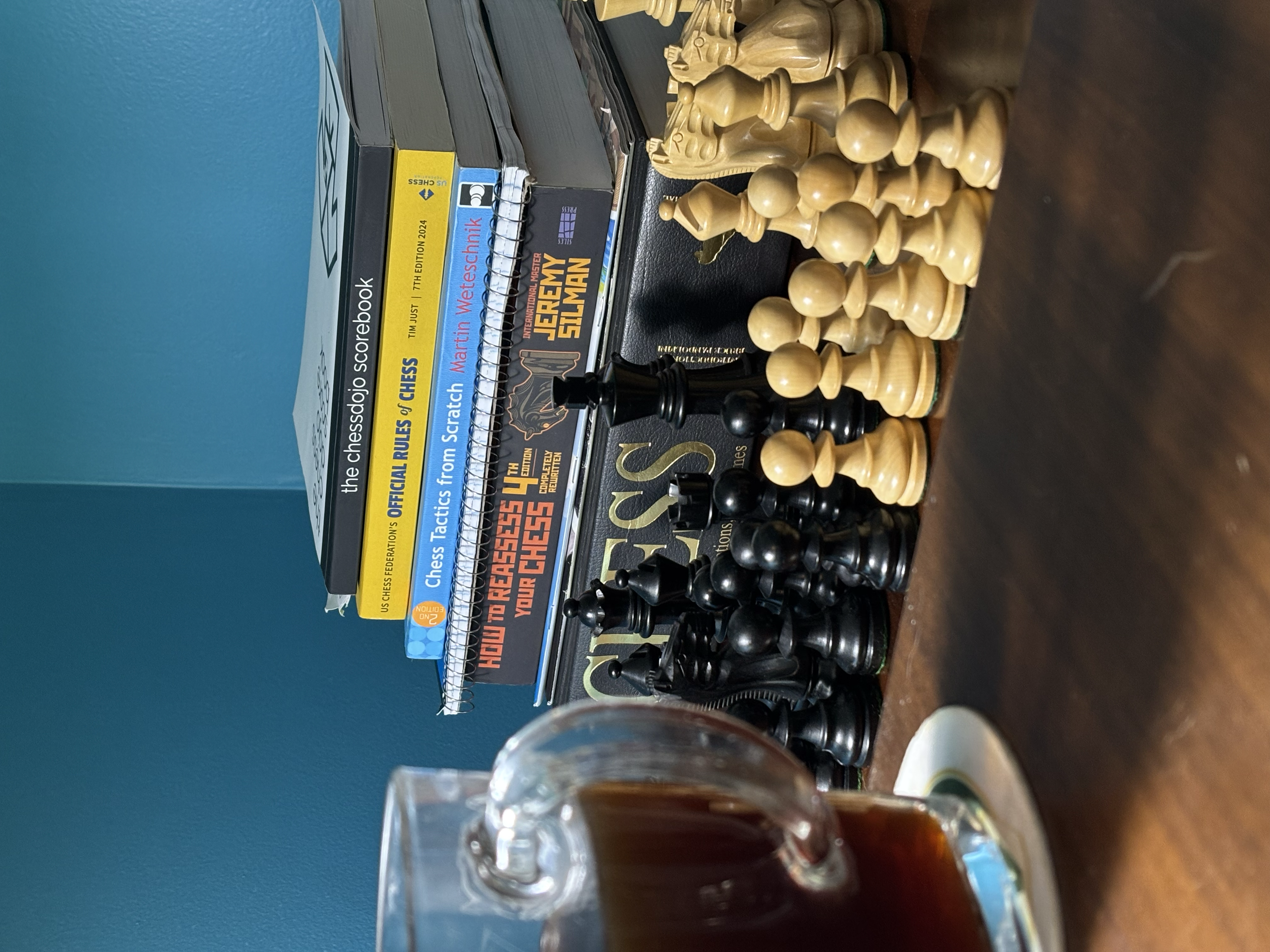
  • These will by my main (Chess Dojo approved!) efforts:

    1. Annotating games from Cincinnati Open (and some other non-tournament classical time control games)
    2. How to Reassess Your Chess by Jeremy Silman
    3. Chess Tactics from Scratch by Martin Weteschnik
    4. Polgar mate-in-2s

    Less important studying, but will be around:

    • Chess Life magazines as they come
    • USCF Official Rules of Chess (I recently became a Club TD and want to keep reviewing to get the book in my bones before next fall’s scholastic season where I can assist.)
    • Drinking coffee and staring at the beautiful chess table and pieces I got for Christmas
    ,
  • Unlike 2020 I didn’t have any goals around reading, but I did try to keep books around as much as possible. I listened to some audiobooks while running, always had a book in progress on my phone, and since we take our daughter to the library all the time I’d make sure to pick a book for myself each time too. In the end I read more than 2020, so there ya go: habits beat goals again.

    Young Guns: Obsession, Overwatch, and the Future of Gaming by Austin Moorhead

    Probably says a lot about me that I’d read a book about video games just as soon as play one. To be honest though I did play a lot more video games in 2021 too.

    The Three-Body Problem by Cixin Liu

    Real trip of a story. Tough to read through translation at times but loved thinking through it. First of a trilogy so will plan to hit the 2nd book in 2022.

    Solutions and Other Problems by Allie Brosh

    So so funny. Hilarious even. Get a taste here: http://hyperboleandahalf.blogspot.com/2020/09/richard.html

    The Power of Habit by Charles Duhigg

    Another one of these books that gets referenced a lot in other books I read… fits in with Talent is Overrated, Triggers, Atomic Habits… Worth the read. Since I take in so many books, podcasts, etc on this topic I felt like I had already heard all the ideas and advice it provided but I could see where for some people this would be the book that clicks for a better life.

    Lives of the Stoics by Ryan Holiday

    A survey history of stoicism, told as the biographies of the school’s leaders and best-known practitioners. Really well put together: enough narrative to keep it from feeling dry, and plenty of great “Holiday-isms” like we’re used to from his previous books.

    The Collapsing Empire by John Scalzi

    Book 1 of the trilogy. Listened on Audible while training for half marathon. I bought this when it was on sale at some point and never got around to listening, but then the other two books came out and I had a half marathon to train for so figured I’d listen to all three while I was running. It was a good idea because I enjoyed the story (over-the-top space opera) so I told myself I was only allowed to listen to it while running. Made me run, made the running fun, which made a good feedback loop.

    The Consuming Fire by John Scalzi

    Book 2 of the trilogy. Listened on Audible while training for half marathon.

    The Last Emperox by John Scalzi

    Book 3 of the trilogy. Listened on Audible while training for half marathon. My favorite one of the three.

    The Call of the Wild by Jack London

    First read this in junior high and it sticks in my mind as the first book I actually tried to interpret past the story itself. Where it’s obviously not just about a dog, even if you like the story about the dog. I liked it even better this time and felt it timely to my season of life.

    Love People, Use Things by Joshua Fields Millburn and Ryan Nicodemus

    The Minimalists are guilty-pleasure self-help and I’m here for it.

    The Inner Game of Tennis by W. Timothy Galloway

    I started playing tennis this fall for the first time in decades. Read this book three times and really helped me enjoy taking up the game.

    Beyond Laravel: An Entrepreneur’s Guide to Building Effective Software by Michael Akopov

    Quick read for the people who’d want it.

    12 Rules for Life by Jordan Peterson

    Enough people talked about Jordan Peterson I’d figured I’d at least read his book. I disagree with him on a lot but respect his willingness to think through difficult topics and stand by his own opinions. But by the end I was pretty sick of him; the kind of person I’d meet at a party, recall it as good conversation, then hope I never run into again.

    The Boys in the Boat by Daniel James Brown

    Great story to end my year. I use a rowing machine a lot, and while I’d never try to compare myself with Olympians it was helpful to remember some of my more painful rows while taking in this story. Makes me thankful for my loving upbringing.

    Honorable mentions

    These books were either partially read, or perhaps are the kind of book you don’t read all the way through… but were considered enough to be worth mentioning.

    • A Journey Through Philosophy in 101 Anecdotes by Nicholas Rescher
    • How to Solve It by George Pólya
    • Walkaway by Cory Doctorow
    • How to Live by Derek Sivers
    • Rebuilding Milo by Aaron Horschig

    Comics

    I read too many comic books to list but wanted to mention a few of my favorites this year:
  • Looking back, I see 2020 as a year of re-establishing my principles. One of those was retraining a habit of reading. In March, my best friend Danny and I started texting each other everyday that we’d read at least 10 pages of a book. Any book counted: fiction/non-fiction, light/heavy, intellectual/dumb. In addition to the following I read many many comic books that I didn’t want to take time to list.

    So while this is not a long list, it’s more than I would’ve read without some intention built in. And now that I’m reading again I’m sure I’ll do more in 2021.

    Skin in the Game by Nassim Nicholas Taleb

    Another entry in Taleb’s Incerto series of books. Fun, interesting, and at its worst still great content to argue against.

    Jump Rope Training by Buddy Lee

    Buddy Lee is incomparable in the jump rope world. This was his first book. It has me convinced to take his seminar at some point. They had one scheduled at a CrossFit affiliate nearby, but like so many other events it was rescheduled then cancelled in response to Covid-19.

    Moonwalking with Einstein by Joshua Foer

    Danny and I thoroughly discussed this on our podcast this summer:

    https://share.fireside.fm/episode/pCUtAqeS+5zVRp3xm

    The Money Tree by Chris Guillebeau

    Quick read, the kind of book you’d give to a high schooler with an entrepreneurial itch.

    Happy City by Charles Montgomery

    Long on my “to read” list from Mr. Money Mustache

    Walkable City Rules by Jeff Speck

    Interesting to read this during a pandemic that seems to counter-punch all the desires of the new urbanists. But got a lot out of this.

    Make Time by Jake Knapp and John Zeratsky

    Heard about this from the Focused podcast. Enjoyable with lots of tips you can pick and choose from.

    An Absolutely Remarkable Thing by Hank Green and A Beautifully Foolish Endeavor by Hank Green

    A novel and its sequel. The second is better than the first but you’d have to read both. This was actually my second or third time starting Remarkable but my mom was so confident I’d enjoy the sequel I made a point to finish it this time. The second half had me page-turning but for whatever reason the first 50 pages just didn’t grab me like you’d think.

    Learning to Breathe Fire by J. C. Herz

    A history of CrossFit and its early prominent figures. Fun read.

    Talent is Overrated by Geoff Colvin

    A predecessor of the sort of content I enjoy from Cal Newport. An exploration into deliberate practice theory.

    Range by David Epstein

    A corollary to Talent is Overrated touting the need for diversity of expertise in both teams and individuals, as opposed to betting on a speciality.

    Station Eleven by Emily St. John Mandel

    A thoughtful novel worthy of its own post; also recommended to me by my mom. It came out several years ago but its setting in a pandemic made it good 2020 reading. Five-stars and would recommend. HBO is making it into a miniseries starring Mackenzie Davis which I’ll definitely watch.

  • You Need a Budget by Jesse Mecham

    The creator of the You Need a Budget (YNAB) software, which I began using recently, wrote this book to publish his philosophy of modern budgeting. Both the software and this book do a good job of not making assumptions about what the user/reader want to do with their money, something very different from other personal finance systems. You could even stay in debt and get value from the YNAB way of things.

    Playing with FIRE by Scott Rieckens

    Read this in one evening. A passionate report on high-earning family starting their financial independence journey. Companion to a new a documentary that’s currently in limited theaters. I loved the book, and while I’m not sure it’ll be my go-to thing to get someone intrigued with FIRE (MMM’s blog is still that for me) it’s definitely good enough for anyone interested to read it. I bet the documentary is great:

    Locke & Key, Vol. 2: Head Games by Joe Hill and Gabriel Rodriguez

    The world-building and art in Locke & Key are exemplary. I think I preferred Vol 1’s story, but their both so enjoyable it’s not even worth ranking. Looking forward to finding a copy of Vol. 3.

  • Mike Monteiro’s new book, Ruined by Design, is an eye-opening take on ethical dilemmas facing/caused by designers. And by his definition even a typist like me is a designer. I was fortunate enough to get my copy signed when Mike was in town last month but it reads just as well unsigned.

    I re-read Deep Work by Cal Newport and found it even more useful this time than I did in 2017.

    Both are recommended reading.

  • Actually read this book a while ago, but just now getting to the review.

    Some very good ideas here, in particular the quick reference material: The Hatrix. If I have one takeaway, its the value of recognizing the differing needs of ‘onstage haters’ and ‘offstage haters.’

    Since I’ve worked in WordPress support both privately and publicly, most of the examples were like familiar friends to me. But there’s a lot of value to quickly noting to yourself: is this hater looking for me to solve a problem? Or are they looking for an audience to validate their feelings?

    Neither is really wrong. I definitely agree with Seth Godin that if you think it’s broken, it’s broken. But identifying the source of the interaction is important in helping to make that hater feel a sense of resolution.

    This book validated a lot of ways we support customers at Automattic. It felt like we’re doing things right (except that, like a lot of companies, we’re still too slow to respond due to overwhelming demand.)

    The writing is less solid. If I wasn’t interested in the topic I wouldn’t have finished this. But the ideas are good. So if nothing else, borrow it, skim it, then go back and re-read the pages that seem to impact your company the most.


    Hug Your Haters by Jay Baer, part of my 2017 Reading

    Amazon | Goodreads | Wikipedia

    http://www.jaybaer.com/hug-your-haters/

  • On the heels of Cal’s So Good They Can’t Ignore You comes Deep Work. If we agree with Cal that becoming good at rare skills is the way to build career capital – then how do we go about doing that? The answer is focusing on deep work, and mitigating shallow work.

    You can read the two books as if they are one. That’s pretty much what I did. There are fewer surprises in Deep Work than So Good, but the ideas are outlined very very wellWe’re on the path of the craftsman, and what makes a craftsman better is deliberate practice. Spending time on the activities that make us more valuable and stretch us to our limits.

    Most humans can only work at their maximum mental capacity for about four hours. And you’ll not likely get that until you’ve trained your mind to do it.

    Learn how to be bored anytime, so that you can combat distractions easily when the time for focus is needed.

    Going deep can take many shapes: the monastic philosophy (refusing anything that would get in the way of deep concentration,)  the bimodal philosophy (going monastic for a stretch then returning to a normal routine,) the rhythmic philosophy (making sessions of deep work habitual, the most practical for many people,) or the journalistic philosophy (mastering context-switching so you can go deep instantly as time allows.)

    Ignore inspiration; instead find your philosophy of deep work and with enough time ‘inspired work’ will occur during those efforts.

    Make time for focus the same way we like to take time away from distraction. “Going offline” can be so appealing, but has way less value compared to prioritizing time to really make strides on hard problems.

    Other tactics:

    • Productive meditation: learn to think on problems while running, walking the dog, or doing dishes.
    • Keep a scoreboard for the deep work you demand of yourself
    • Add a shutdown ritual to the end of your work
    • Schedule every minute of your day, then use it as a guide (not as a rule.)
    • Do the shallow work better too – so that you can do less of it. In particular, write better emails.

    Deep Work by Cal Newport, part of my 2017 Reading

    Amazon | Goodreads | Wikipedia

    http://calnewport.com/books/deep-work/

  • Cal Newport’s rules for career building. I’ve never read a book that seemed more enlightened on the topic.

    Your motivation has nothing to do with making your career better. The way you work is everything.

    “Follow your passion” is bad advice for becoming happy with your work.

    Instead,  get good at working, and you’ll gain passion for the work. There are some jobs where that’s not going to be possible, and Cal provides some ways to identify them. Get out of those jobs and instead find work in a field where you can develop a craft worth developing.

    Gain career capital. Do difficult things that most people cannot or will not do, and get good at those things. This career capital makes you valuable. Some industries will require you to become valuable at only one skill: ignore other skills and maximize that one. Other industries will reward more diversity. Identify which approach your market requires, and follow through.

    Once you’re working well, and have earned career capital, spend that capital on control. Use that control to make your career fit your life’s mission. Pursue your mission with the craft you’ve painstakingly trained.

    This mission, control, and passion comes because you do good work. Not the other way around.


    So Good They Can’t Ignore You by Cal Newport, part of my 2017 Reading

    Amazon | Goodreads | Wikipedia

    http://calnewport.com/books/so-good/

  • “The passion hypothesis is not just wrong, it’s also dangerous. Telling someone to “follow their passion” is not just an act of innocent optimism, but potentially the foundation for a career riddled with confusion and angst.”

    -Cal Newport in So Good They Can’t Ignore You

  • Another Audible listen by John Scalzi, narrated by Wil Wheaton. This experience was even amplified by Ber making her way through Star Trek (the original series) on Netflix. So every time I came back from the gym where I listened to Redshirts, she’d be watching Trek and I couldn’t  help but laugh.

    Redshirts is to science fiction what Last Action Hero was to Arnold’s movie career. You don’t have to be into Star Trek to enjoy it, but it’s a lot more fun if you’re already in on the joke. Basically: what would happen if all the people that died just for the sake of screentime action realized they were being suckered?

    Wil does some amazing voice work in this one. In particular a great little conversation in an alien language. The words-on-a-page version I’m sure is good, but I finished it really happy to have gotten it on audio.

    Scalzi won the Hugo award for Best Novel with this book, but I think his Old Man’s War universe is still better overall. He just happens to play some tunes that appeal to all readers in this one. A good read for the science fiction lover or the reader who only occasionally picks up the genre.


    Redshirts by John Scalzi, part of my 2017 Reading

    Audible | Goodreads | Wikipedia

    Books and Other Projects by John Scalzi