Category: Books

  • Renewed interest in reading is a recent success in my attempt to be a less horrible person. It would shock many of my friends to learn just how few books I’ve actually read. Dune is one of the several books that come up in conversation as, “how have you not read that yet?” along with 4 out of 7 Harry Potters and anything at all by Issac Asimov.
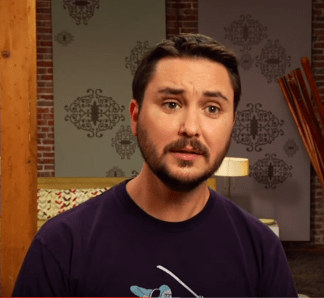
    Wil Wheaton asking, "Do you not know how to read?"
    Do you not know how to read?

    As Wil Wheaton joked on TableTop: “Do you not know how to read?”

    Credit goes to my friend Ash (with an assist from Simon) for getting me to startup Dune late last year. It had been on my reading list since December 2014, 2015 was the 50th anniversary year of the book’s publication, and I needed more science fiction in my brain. Clearly the book needed reading.

    Another element of ‘real life’ that made this book so wonderful was that it also coincided with my deep dive into the world of Dungeons & Dragons, 5th edition. Reading a lot about world building, storytelling, and resolving characters’ flaws, desires, and choices was a perfect pairing with a book that does all those things so well.

    Herbert tells a story of espionage and intrigue in a way that let’s the reader feel like they understand everything at play, but still holds enough back that the big surprises within the plot leave little ones for the reader who thought all had been understood. Dramatic irony at its best.

    The characters are all somewhat of a caricature, and I think that’s why part of me loved it along with the D&D research. There’s a guideline in D&D called ‘the rule of cool‘ — if your player wants to do something that’s a stretch of reality, still let them do it for the sense of adventure. It’s suspension of disbelief that makes the heroes of legend so great. Dune crafts a larger story arc so real it lets the people involved be larger tropes than suspension of disbelief would normally allow.

    In the final moments of Dune, the Emperor accuses Paul Atreides of assuming overconfidently that he can do whatever he wants because of his Fremen-earned power on Arrakis. Paul then basically does whatever he wants, impervious to any attack or error. Sounds like the boss battle in every JRPG or D&D campaign ever, except he’s not even a scrappy underdog who’s barely leveled up enough to win. He’s an overpowered, all-time-and-space-seeing übermensch who goes berserk if you mention his dad. It’s a little weird if you think about it too much.

    But all that seems normal in the epic scope you spent 600 pages reading before you get to that. You’re too excited to care if its a little inflated. Does Muad’dib kill the bad guy or what?! Will everyone break into giant space war?! Is there a elaborate ruse waiting behind the final door? What do the sand worms taste like?!

    It’s a very good book and worth every minute spent on it. I took my time mostly because I spent too long trying to read the paperback copy when I wasn’t holding the baby when I should’ve been reading it on a Kindle while holding the baby. I switched to the latter method after a couple months and finished the last half of the book in a week.

    2016-03-15 16.54.18
    Dune on Kindle with avid reader cat, Bagheera

    Funny enough, I just so happened to come across a Dune spoiler while I was reading the book. It was in a video a guest contributor posted on Wil Wheaton’s blog. You don’t really need spoiler alerts for movies that are 20 years old based on books that are 50 years old, but I had no idea people were going to ride the damn sand worms.

    Oops. Spoiler alert.

    Lastly, I really want to play in an RPG based on Dune. There’s technology, but no computers or internet. There are still swords and shields but they’re used beside lazer guns and rocket launchers. The DM would have to explain psychdelic hallucinations just as much as any combat encounter. So great. So if you can recommend somewhere where this exists, please let me know.


    Dune by Frank Herbert, part of my 2016 Reading

    Amazon | Goodreads | Wikipedia

    http://www.dunenovels.com/


  • Last year I aimed for 15 books and ended up reading 18. I also let myself start almost a full month early, but the reality is I wasted more than a month not reading at all during the year. So this year I’m aiming for 20 books. Hitting those 20 books won’t really be so much about adding new reading time so much as keeping up the consistency month-to-month.

    It also doesn’t hurt that I plan to read a ton of John Scalzi’s books and I read his stuff quickly. It’s fun material and his voice resonates so well with me I just never put the books down. I even put one of his non-fiction books on the list.

    For the purposes of planning I don’t add books that are more technical / reference in nature. However if I do end up reading one of those cover-to-cover and writing a review of it (as it looks like will happen with at least one JavaScript book) I add it to the list later on.

    These are in no particular order, and I edit the list as I go throughout the year:

    1. Dune by Frank Herbert
    2. Getting Things Done by David Allen
    3. Project Management For You by Cesar Abeid (late addition)
    4. Zoe’s Tale by John Scalzi
    5. The Name of the Wind by Patrick Rothfuss
    6. You’re Not Fooling Anyone When You Take Your Laptop to a Coffee Shop by John Scalzi
    7. The Curious Incident of the Dog in the Night-Time by Mark Haddon (audio, late addition)
    8. Lock In by John Scalzi
    9. American Gods by Neil Gaiman
    10. Hug Your Haters by Jay Baer (late addition)
    11. Flow by Mihály Csíkszentmihályi (late addition)
    12. CivilWarLand in Bad Decline by George Saunders
    13. The Icarus Deception: How High Will You Fly? by Seth Godin
    14. The Human Division by John Scalzi
    15. The End of All Things by John Scalzi
    16. The Android’s Dream by John Scalzi
    17. Redshirts by John Scalzi
    18. A Beautiful Constraint by Adam Morgan and Mark Barden
    19. Setting the Table by Danny Meyer
    20. A More Beautiful Question by Warren Berger
    21. Notes From a Small Island by Bill Bryson
    22. Casino Royale by Ian Fleming
    23. Sheepfarmer’s Daughter by Elizabeth Moon
    24. Antifragile by Nassim Nicholas Taleb
  • Some books just grab you and don’t let go. I wasn’t even expecting to read this book last weekend. On Friday I got an email saying my library’s ebook version of The Martian was now available and was automatically checked out for my account. All I had to do was open up my Kindle and let it download. I got hardly any sleep after that until I finished the book.

    https://twitter.com/alexjgustafson/status/675665420754513920

    A Perfect Story?

    Picking out favorite parts of this plot is nothing but spoiler country, so I won’t get into details. Thanks to the movie that came out, everyone knows the story is about astronaut Matt Damon Mark Watney being marooned on mars. The book could have a much worse plot and still be entertaining for most because of the humor Watney uses to make light of his unconscionably hopeless scenario, but that’s not what makes the book great.

    What makes the book so appealing is that Weir lets the plot do its own development. Everything that seems to work well carries with it the seed of another problem. The book could’ve gone any number of directions because it’s amazing anything Mark does works at all. Every little victory carries so much risk it’s easy to rejoice for today and have your heart torn out tomorrow. Your blood will pump hoping for Mark’s safety to the very last page.

    There’s little need for suspension of disbelief, because the problem-solving sounds like an annoying process you’d face at work. Little details you’d never consider except in a weird edge case. Mark just faces them while alone on Mars with limited supplies. Even the technical language doesn’t come off  as mumbo-jumbo like the stuff you’d read in a Star Trek novel, it’s basic ideas that need grappling. How efficient can a solar panel be? How do you make water from scratch? These aren’t scientific ideas that need faking, they just need to be explained in an entertaining context.

    Not a Perfect Book

    2015-12-18 15.42.51.jpg
    The Martian Kindle Edition with avid reader cat, Bagheera

    The book still falls short in a lot of little moments. Almost every bit of dialogue (this doesn’t include Watney’s narration that drives most of the book) felt flat. Even when Watney does the talking, half the time it bits of moaning like ‘well, shit’ or a string of expletives.

    I get it, it’s an impossible situation and your mad and mad people swear a lot. But this is the fifth time I had to hear it. Stop trying to talk at me, make a joke, then get back to trying to build a radio out of coconuts. I like coconut radios way more than your soliloquy.

    Thankfully Weir limits the amount of interaction we have with other characters, so we don’t listen to their crappy dialogue any more than necessary. It’s this reason the movie may actually be better than the book, because there’s no reason the movie can’t have the same amazing plot, but good actors and screenwriter’s view of dialogue could really whoop it into shape. I’ve not seen the film yet, so feel free to tell me I’m wrong.

    Making Up For It

    Don’t let the thought of poor dialogue get you down though – the majority of the book is just so much stinking fun you’ll not give it another thought until you need to write a book review. The first night I was reading, I kept telling Ber, “You really need to read this book.” Over and over.

    Eventually I had quoted so many little lines to her she said, “turns out I just have to listen to you read it!” I tried to stop, but I couldn’t completely.

    Weir originally wrote The Martian as a series of blog posts. Arguably, what makes a blogger a blogger is the desire to share information, and this book is a joy to share. I’m not surprised it spread as quickly as it did and eventually got picked up for full-on publishing. I think it spread well even early on because the story comes off as so likeable. And Watney’s humor and wit are almost assuredly just moments of Weir projected into the work. It’s a book that makes you want to grab coffee with its author.

    And that’s why I’m here with you, too. As soon as I finished it I wanted to share the experience of it.

    https://twitter.com/alexjgustafson/status/676263250007343104


    The Martian by Andy Weir

    Amazon ; Goodreads ; Wikipedia

    andyweirauthor.com

  • When my mother got word that I was getting into drawing, she supported it whole-heartedly. For my birthday, she got me a sketchpad, art pencils, and Art Before Breakfast by Danny Gregory. Not only does the book exude a can-do attitude that everyone is capable of making art, but it excites the reader into doing so almost immediately.

    Danny is also an excellent blogger who uses WordPress.com to host his site. He has an excellent series going on the ‘seven deadly creative sins.’ He also has many posts where he goes through the same creative exercises in this book. In today’s post he shared this lovely video where he does some urban sketching with a friend:

    What makes the book enjoyable is how approachable Danny keeps his topic. It’s easy to fall into the trap of refining techniques and insisting on dull exercises that exemplify them. But Danny focuses on keeping his reader excited to draw. He likens taking out the sketchbook to draw to the way smokers reach for their next cigarette. It’s done as a habit, regardless of where you are or what obligations you may be facing. But instead of sickness, we instead teach ourselves the delightful habit of making art all the time and everywhere.

    After any session of reading I felt strong urges to draw and I’m beginning to reach for my sketchbook more and more. Style? Technique? Competence? I’ll learn those things overtime. Most importantly right now is that I pick up the pencil and go for it. Here’s a few from Wednesday night:

    A sketchbook full of drawings, even lousy ones, is far more beautiful than one full of blank pages. Thanks, Danny, for teaching me that. Thanks, Mom, for the birthday gifts.


    Art Before Breakfast: A Zillion Ways to be More Creative No Matter How Busy You Are by Danny Gregory

    Amazon ; Goodreads

    Art Before Breakfast on dannygregorysblog.com/

  • My team lead, Simon, and I have a one-on-one chat every week. It’s typically casual in tone but big picture in topic. At some point in an August chat, we hit the topic of managing people. Recently this book has been read by several Automatticians and Simon is one of them. He recommended I read it too after we typed at each other a bit.

    2015-10-21 11.00.30
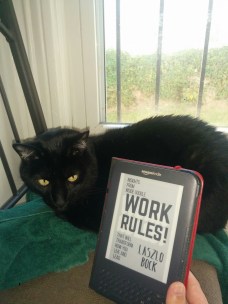
    Work Rules on Kindle eBook with avid reader cat, Bagheera

    The most interesting thing about this book is how much it reminded me of Automattic. We focus a lot on employee freedom and that’s a major tenet presented. Bock mentions a conversation with another company’s HR lead and how they were interested in trying things like a room with lava lamps and beanbag chairs, but not giving the employees more freedom, responsibility, or transparency. Good ideas pretty much stop with that roadblock of less employee freedom.

    Another great discussion in the book is around the topic of managers. It’s a commonly bemoaned thing in tech that managers just get in the way of engineers, but this book showed the steps that Google took to show that while bad managers do indeed just that, good managers are invaluable and make their teams better. One of the big decisions that kept Google managers good at their role was distancing them from acts of compensation and promotion.

    At Automattic we have a similar philosophy: we don’t have managers, but we do have team leads. Simon is my lead, but is not my boss. Team leads are charged with making sure the team does the very best work we can do, but they can’t decide on their team members compensation unilaterally. Our HR team does compensation reviews rather thoroughly, and the team lead’s opinion is only a part of that. As was recently put at the grand meetup, Happiness Engineers like myself bring happiness to customers. Team leads bring happiness to Happiness Engineers. Same job, different purpose.

    You might also enjoy this book for a more thorough view of why Google has the ‘fun’ perks it does like the free food and napping pods. There has been tons of media coverage over those little things in past years. But instead I hope you’ll read this book and help your business shape the way it sees its people. For now, I see it as a pat on the back that Automattic really is doing things at the top tier of HR and strive to make myself an employee deserving of such a great team.


    Work Rules!: Insights From Inside Google That Will ransform How You Live and Lead by Laszlo Bock

    Amazon ; Goodreads ; Wikipedia

    WorkRules.net

  • I have trouble speaking up unless I’m absolutely sure what I say will be the right thing. Last night I was reading Work Rules by Laszlo Bock and hit this passage…

    One leader, who had been cautious about wading into issues outside his area of expertise, was told, “Every time you open your mouth you add value.” For years after, he told me, that one bit of insight from a colleague encouraged him to be a much more active member of his team.

    My reaction…

    huh

  • Upon completing Mint Juleps with Teddy Roosevelt, I met my goal of reading 15 books in 2015. It all happened more easily than I thought – three months early!

    Taking another look at the 2015 reading list, I notice that four of the books were late additions (meaning that I added them to my list after making the inital fifteen books in December.) I have six more books chosen to read, and only two of those are late additions. So I wonder if maybe the next goal for 2015 should be to finish the original list?

    Dunno. Maybe not.

    I’m now reading Work Rules! by Laszlo Bock which happens to be a late addition itself. But this choice was partially of convenience. My Kindle 3G died last year, but my mom recently upgraded to a Kindle Paperwhite and gave me her old 3G. Work Rules! happened to be available in Kindle format from my library and that was a very convenient way to obtain some reading indeed.

  • Most people that don’t work in technology probably know the name Peter Thiel from watching The Social Network. Or maybe from when the Thiel Fellowship started, asking talented young technologists to put off college for a couple years and build startups instead. But if you work in tech you probably know that he’s a vocal and talented venture capitalist whose ideas are worth listening to, trying, and experimenting with in your own world.

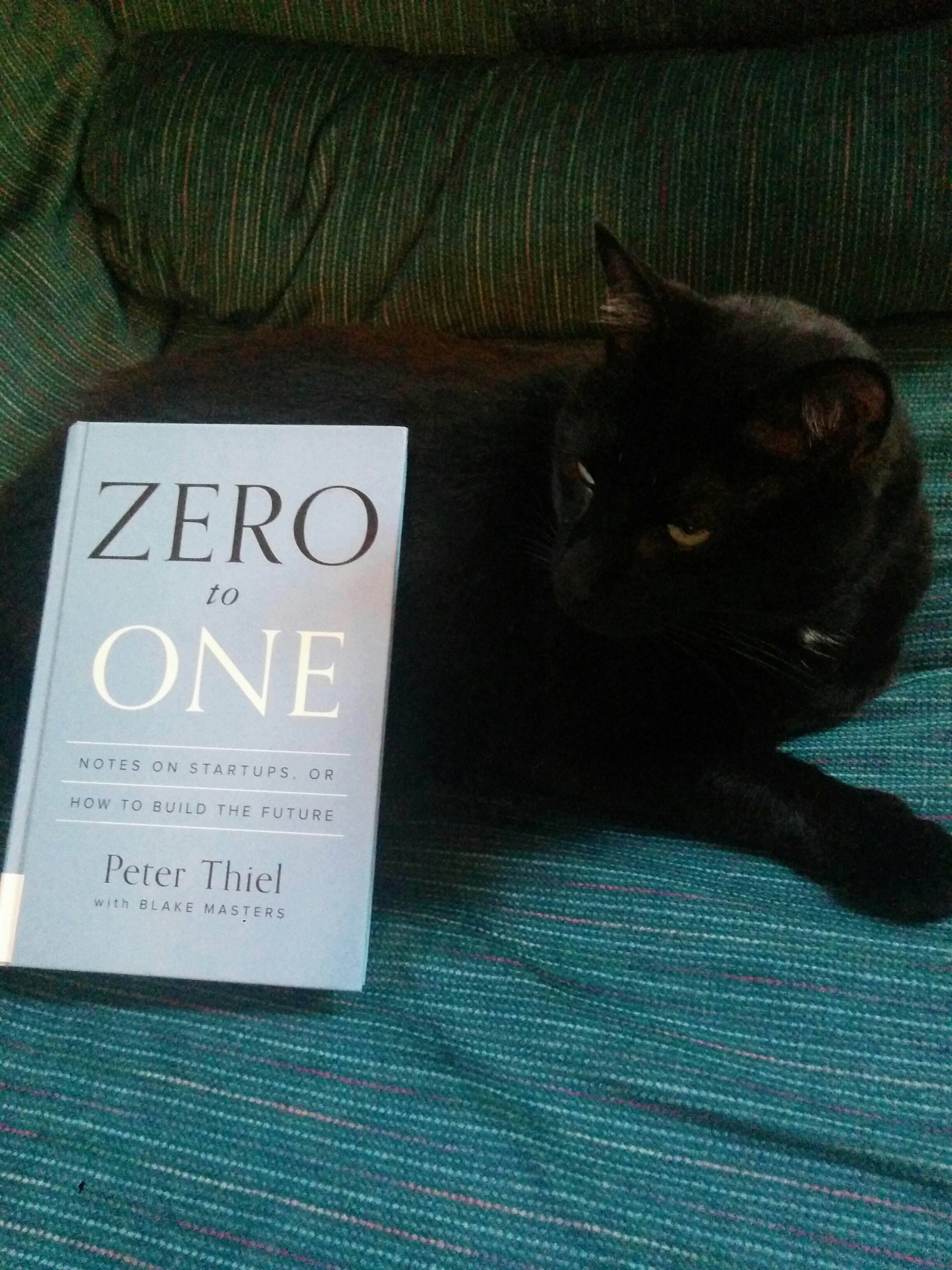
    Zero to One in hardcover with avid reader cat, Bagheera
    Zero to One in hardcover with avid reader cat, Bagheera

    This book is built out of notes from a course on running a startup that Thiel gave at Stanford University in 2012. Blake Masters was a law student who attended the class and took copious notes. The notes are still available online. After they got a lot of attention and readership, Thiel and Masters developed them into what is now a compact read that examines the needs of success in the difficult environment entrepreneurs face.

    Unlike some other business reads I’ve written about, you’re not going to find any fluff here. Thiel takes his ideas seriously and defends them well. But it’s also a book that will leave you with more questions than answers. There’s no guaranteed answer or advice you can give to make a startup successful, and Thiel doesn’t lie about that. But you’re a lot more likely to play the game well if you understand what you’re getting into.

    This is a must-read for anyone wanting to start any company ever.


    Zero to One: Notes on Startups, or How to Build the Future by Peter Thiel with Blake Masters

    Amazon ; Goodreads ; Wikipedia

    http://zerotoonebook.com/

  • I’m usually not much for biographies or memoirs. Normally with non-fiction I tend to read business books, or books for helping me learn a skill. But I love everything Felicia Day creates so I needed to read this one.

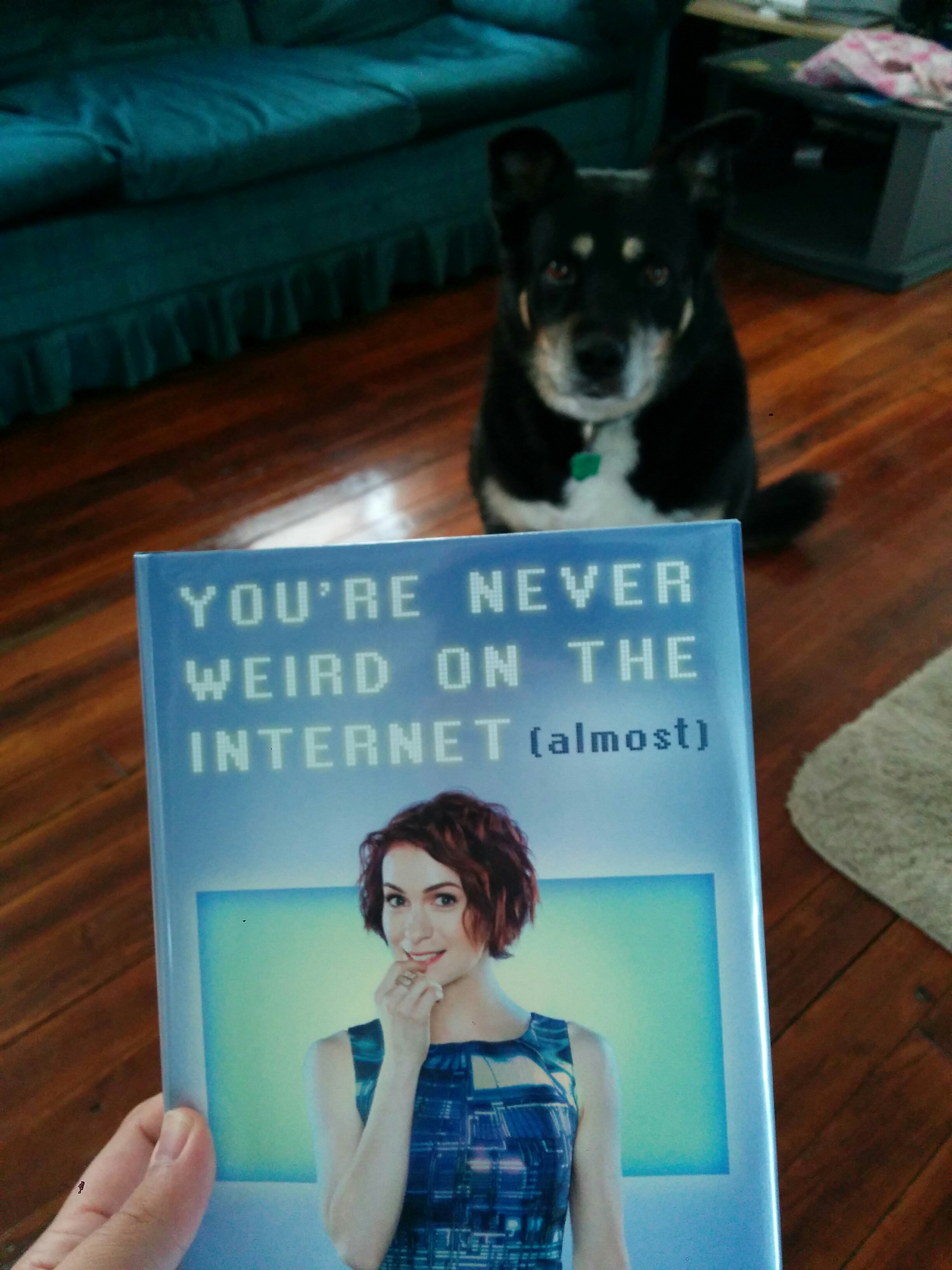
    You're Never Weird on the Internet hardcover with dog
    With avid reader pup, Nada

    More accurately, I needed to read this one after Amber finished it. While I wanted to read the book someday, my 2015 reading list was so cram packed I wasn’t sure I’d get to it anytime soon. But Amber wanted to read it right away, so we requested it from the library when it was still in preorder. Once the book was released, she was one of the first to get it. I decided to fit in the read before the book had to be returned for the next library patron who requested it.

    It’s a super fast read in a good way. Her stories are entertaining and engaging, so 20 pages a night is nothing when you could read 50 and giggle 2.5 times as much! And giggle all the way through is what I did.

    This book is best read by someone who already knows and loves who Felicia Day is, she says so herself. Haven’t watched (or at least heard of) The Guild? Ehhh, maybe you won’t giggle as much.

    But the memoir is smart as much as it is funny. I respect her even more having heard her story and the struggles of her creative life. Really glad to be in her audience, and really thankful to hear more about the person behind the online avatar.


    You’re Never Weird on the Internet (Almost) by Felicia Day

    Amazon ; Goodreads ; Wikipedia

    http://feliciadaybook.com/

  • On our way to and from Fort Smith, Arkansas, Amber and I listened to A Game of Thrones on audiobook. It’s such a cultural touchpoint now, but we’re both very behind on the books, the tv series, everything. I have only seen three episodes of the series, and Ber has seen the first season of the series. Neither of us have read the books.

    Even with twenty-two hours of driving, we still only ended up listening to half the book. It wasn’t from lack of trying, it’s just a very long audiobook! But it was a totally awesome experience. Roy Dotrice is an incredible talent of voice acting and the characters really came to life. To an extent, I’m glad I started with the audiobook instead of reading. Though now it’s been several days and we’ve not continued listening so we might need to read to finish it.

    Looking up more about Roy Dotrice, I found this interview and especially enjoyed it.

    He seems so sweet and caring. His love of George R.R. Martin’s work really came through in his performance and it sounds like it comes from a genuine place.