I really like the artwork at my new co-working space. Right now I think all the pieces are created by Brittany Anne Jennings.
-
David Cain made a post today on Raptitude.com that really struck with me:
She said that for years, a colleague of hers (Peter Gzowski?) insisted on making frequent trips to a remote cabin up North, where he spent the time chopping wood, reading books and walking with his dogs. When she asked him why this ritual was so important to him, he said, “Well… I guess I really like who I am when I’m up there.”
Rodgers explained her departure by saying that the morning show had made the reverse true for her: the job required her to wake up at 3:30am, shuttle herself to the studio, and force herself into professional-mode hours before the sun came up, and she didn’t like who she was when she was doing that.
When I heard her say that, I was sitting in my office at work, and realized I that definitely didn’t like who I was when I was in there. I didn’t like who I was when I was on the phone with clients, or out talking to contractors, or sitting at pre-construction meetings. (read it all, here)
Like Shelagh and David, there was a time when I too could sit a desk and not just be displeased with a situation, but be displeased with who I was. I didn’t like who I was when I cold called for hours on end. I didn’t like who I was when I had to make excuses or explain my job-poorly done.
But now I really like who I am most of my minutes every day, and I just wanted to share a little list. I like who I am when I…
- … offer nerdy after-thoughts when announcing the answer at trivia.
- … help a WordPress user learn something new.
- … make breakfast for my wife.
- … roll a natural 20.
- … roll a natural 1.
- … finish a book I’ve been reading so very slowly for a long time.
- … walk my dog until she’s so tired she sleeps for hours.
- … ride my bike with no route in mind.
- … ride my bike with 50 pounds of groceries in tow.
- … ride my bike at all.
- … know that I’m on working on the best possible thing I can be working on right then and there.
- … talk things out with my wife.
- … solve a problem that could never have been solved in another time of my life.
- … think about my future.
- … when I (edit) typos in my headlines. 😀
—
-
When I started reading this book, I didn’t think I’d have to be smart to talk about it. Turns out, you kinda have to be smart to talk about this book — at least to do so without being called an idiot by its author, Nassim Nicholas Taleb (also known as NNT). But then, he’s likely to call you an idiot regardless. Before I even started reading the book, a twitter friend even mentioned it:
He’s calls lots of people morons, stupid, unintelligent, and the like throughout the book. I’m not one to say he’s wrong, and perhaps I should count it a blessing that I don’t have dealings with too many people of great power.
But honestly reading the book made me feel less stupid. Mostly because with my small exposure to statistics in business school, I felt like an underlying question I had was always ignored:
The models you’re teaching us assume that we understand the system in which we’re using it — what do we use if something happens from outside our assumptions?
I would be dismissed as if I was asking an illogical, purposeless question. My question would not at all help me compute the homework being assigned to me that night. But now I understand that’s a question almost all experts refuse to grant any consideration, and that made me enjoy the book throughly. In particular, I liked story in Chapter 9 where NNT explains how the probability found in casino game (dice/card/roulette) is not at all the randomness he works with. All those probabilities are understood, and in the context of a Casino are controlled to the house advantage (so long as the Whales are kept at bay from large bets at the right time using Maximum Bets) and by risk management to spoil cheaters. But the real Black Swans for the casino ended up being when a tiger attacked a main stage performer, when a contractor was hurt during new construction, and when a corporate drone completely forgot to file a very important document with the IRS. All of these are far less predictable, and far more hurtful to the casino’s business than a card-counter playing Black Jack. But how does one mitigate such things?
NNT describes his Black Swan problem — when events that are both improbable and unknown cause massive consequences — but also the important Turkey problem. If you are a turkey living with a farmer, and are fed well everyday for 999 days, what do you expect to happen on day 1000? The answer is obvious to one with the wisdom of the farmer, that not only will he not be fed, but he will meet his end. If not on day 1000, most certainly at another day in the future. And the exact day doesn’t really matter, nor change that certainty. But to the Turkey, day 1000 was a Black Swan. How could he have ever predicted something so beyond the realm of his knowledge?
Don’t be the turkey. Don’t be a sukka. (I love that NNT uses that term like my favorite blogger Mr. Money Mustache does.) Understand that randomness is bound to impact your life at grand scales.
What you won’t find in this book are the fantastical 10-simple-steps-you-can-take-right-now-to-win that so many other “thinking books” try to leave with the reader. No one has them, and Taleb at least has the guts to say he can’t predict the Black Swans any better than you or I could. The only difference is that he’s slightly less shocked when they come. In some aspects of life… that negative knowledge can be rather useful.
I recommend the book. I’m not smart enough to do it justice or talk about it. I’d like to think I’m smart enough to say I don’t know plenty of other things too.
The Black Swan: The Impact of the Highly Improbable by Nassim Nicholas Taleb
—
-
Dr. Michael Tunnell, trumpet professor at University of Louisville, passed away recently. Several of his former students performed this at his funeral:
He was the kind of teacher that could make anyone wish they played trumpet.
—
-
I’ve had Google Fit on my phone since upgrading to Android 5. I’ve used pedometers before, but for whatever reason I never was very consistent with checking them. Wearing? Not a problem. Actually learning or tracking anything? Problem.
Google Fit excels where I had previously failed. I find myself constantly checking the Android app and occasionally peeking at it on the Web too. Honestly, I probably look at it too much, because so far it hasn’t really driven me to adjust too many habits but it does lead me to remark almost every day that I don’t have enough activity.
Amber thinks it’s creepy that my phone “tells me [I’m] fat” but I think she’s mostly sick of hearing me say the phrase “Google Fit says…”
Today I made a point to work a different coffee shop, about a mile away, to see how many steps it was. The answer? 2,058 each way – about what I was expecting. The thing is, this makes me believe even less that I can actually make the time to hit 10,000 steps a day. The walking commute didn’t feel inconvenient, but the walking commute plus another 6,000 steps “somewhere” seems nearly impossible in terms of the time required alongside my workload.
So if anything, the Google Fit has strengthened to me the idea that aerobic-only exercise is probably a terrible idea for my lifestyle. I need to genuinely seek out a strength training solution to shock my muscles into change with less time.
But the walking commute and it’s 4,000 steps will probably stick around, too.
—
-
Upgraded Stats and Navigation Enhancements.
I’ve had the pleasure of testing out a lot of the new changes happening at WordPress.com. This new stuff is seriously exciting for us!
-
My wife gave me a mini code challenge for her post today.
She wanted to hide some spoilers from a book review. We’d rather hide the spoilers behind a click or hover, and I normally would accomplish that with a bit of jQuery, but her blog is hosted on WordPress.com so interactivity wasn’t really an option with only CSS available for editing.
A simple, one-time solution could’ve been to change the text color of the spoiler to the same as her background color, allowing the reader to highlight the text and read the text. But I wanted to give her something she could use again in future book reviews, so this little CSS class seemed easy enough.
I helped her wrap the spoiler text in some span tags:
<span class="spoiler-text">Spoiler</span>Then added this CSS to her WordPress.com Customizer.
.spoiler-text {
     background: #574d4d;
     color: #574d4d;
     display: run-in;
}

.spoiler-text::before {
     content: "Highlight to read Spoilers";
     color: #fff;
     display: run-in;
}
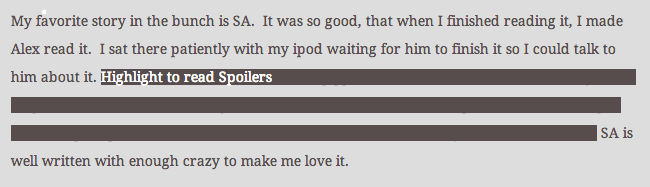
The result is an inline block of color you can highlight to reveal the spoiler, with a note added.
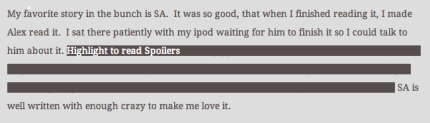
The color #574d4d was her original text color, so that’s what I went with for the color block. Changed the text color for the class as well in case she edits her default text color in the future.
She liked this well enough so it’s up and running. 🙂
Leave a comment if you have other ideas on how to handle spoiler text with only CSS.
-
Amber wrote on her blog about how we both see ourselves as readers, but when you look at how many books we’ve read this year– we’re not really readers. We just see ourselves that way and we should better strive to meet that expectation.
I’m pledging to finish 15 books between now and the end of 2015. I’ve already begun books one and two, so I figure if I get both of those done, plus one book a month next year, plus one more (somehow) in there — I’m doing pretty good. To most readers, that’s a ridiculously low number. I don’t care. This is ambitious for me.
Here’s my book list of what I want to read in that time. If you have suggestions to fill out remaining spots, please leave in the comments otherwise I’ll figure this out as we go along. I also reserve the right to remove a book if I start it and really don’t get into it, so long as I replace it with another book.
If I get any books for Christmas I’ll probably sub those in too. 🙂 (Edit: I did, and I have.)
- The Black Swan: The Impact of the Highly Improbable by Nassim Nicholas Taleb
- The Fall of Hyperion by Dan Simmons
The Call of Cthulhu and Other Weird Stories by H.P. Lovecraft- The Alchemist by Paulo Coelho
- Endgame: The Calling by James Frey and Nils Johnson-Shelton
- Old Man’s War by John Scalzi
- The Books of Magic by Neil Gaiman (late addition)
- The Ghost Brigades by John Scalzi
- Taking People With You: The Only Way to Make BIG Things Happen by David Novak
- The War of Art: Break Through the Blocks and Win Your Inner Creative Battles by Steven Pressfield
- The Last Colony by John Scalzi (late addition)
- The Postmortal by Drew Magary (late addition)
- Quiet: The Power of Introverts in a World That Can’t Stop Talking by Susan Cain
- You’re Never Weird on the Internet (Almost) by Felicia Day (late addition)
- Zero to One: Notes on Startups, or How to Build the Future by Peter Thiel
- Mint Juleps with Teddy Roosevelt: The Complete History of Presidential Drinking by Mark Will-Weber
- Work Rules!: Insights from Inside Google That Will Transform How You Live and Lead by Laszlo Bock (late addition)
- Art Before Breakfast by Danny Gregory (late addition)
- The Martian by Andy Weir (late addition)
- Dune by Frank Herbert (read in 2016)
- The Name of the Wind by Patrick Rothfuss (late addition | read in 2016)
- American Gods by Neil Gaiman
CivilWarLand in Bad Decline by George Saunders- The Icarus Deception: How High Will You Fly? by Seth Godin (read in 2017)
—
-
I had a good time in Austin, TX this week.

The Austin Skyline from South Congress. More importantly, I actually got to meet my first round of Automatticians in person. We ate a ton of good food, did a lot of fun stuff, and did a lot of work. We’re a fully-distributed company, so we normally we only communicate online. When you put us in the same room, it’s kind of amazing how quickly a big project can come together. We also shared a lot of ideas and I’ve got a lot of new tools I’m ready to take home and make my day-to-day more productive.
Now I can’t wait for my team’s meetup in 2015. 🙂

 Alex "Gus" Gustafson