Tag: rpg

  • This is the fifth and final post in a series called “To Switch or Not To Switch” about whether or not my gaming group should switch to Dungeons and Dragons, 5th Edition, or stay with Pathfinder.


    Our gaming group discussed the switch a couple weeks ago. It didn’t take long to realize that some folks were excited about one option, and everyone else was happy regardless of the system we used. We all agreed the most important thing is that we like playing together.

    Once our current storyline is complete, we will be switching to Dungeons & Dragons, Fifth Edition, for our system.

    There will be some details to iron out. Some folks would like to keep their characters and others are thinking they’ll roll up new ones. Some folks like the prospect of the long adventure path, some prefer we keep making our own stories. We’ll face those as they come. It’s likely we’ll need the rest of the year or more to finish out our current campaign anyway. Since we only meet every 2 weeks, we likely will only have 4 or 5 more sessions before Amber and I are in newborn-baby-mode.

    Since the switch has been decided on, some cool stuff has happened.
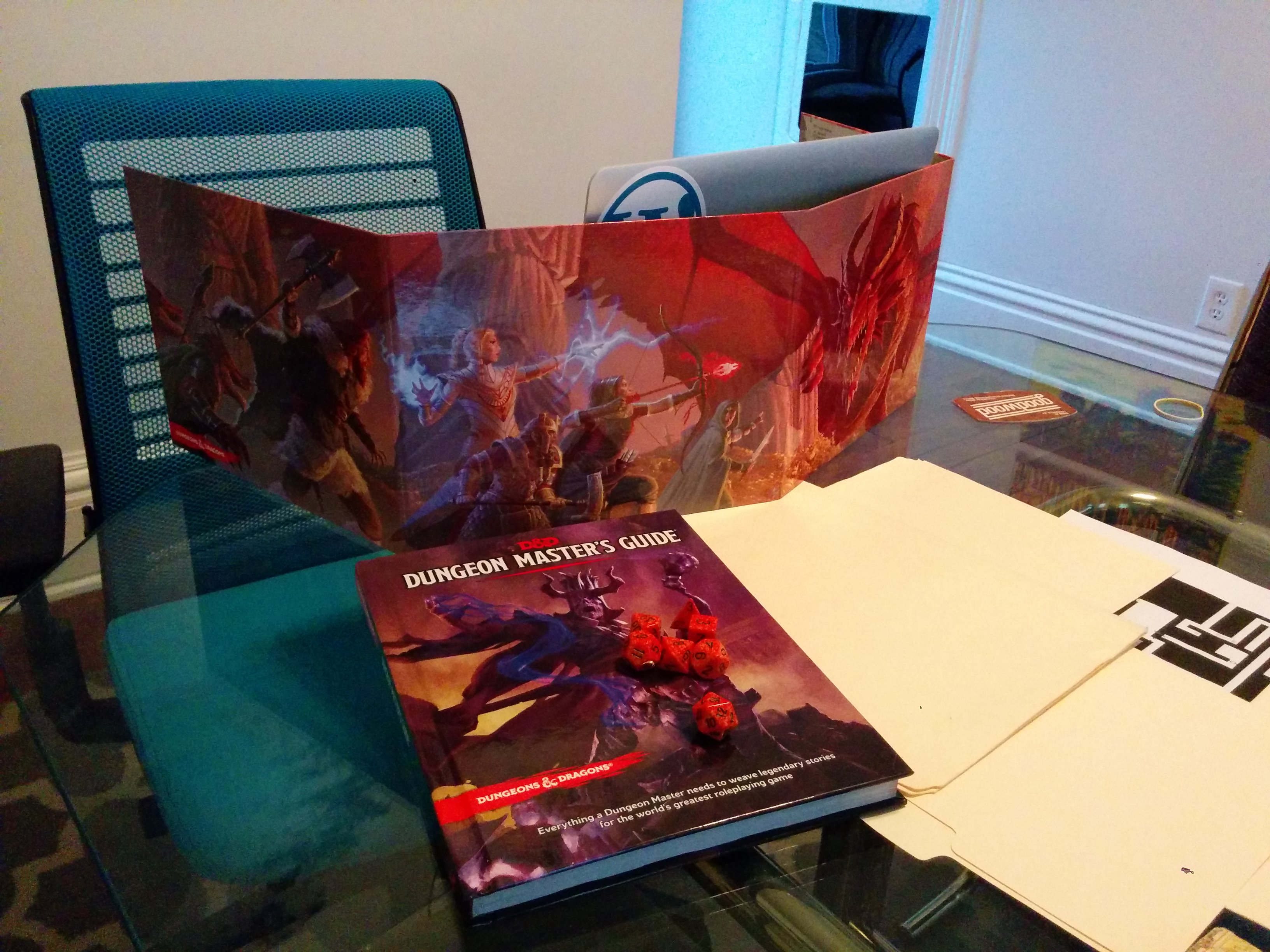
    The 5e Dungeon Master Screen, Dungeon Master's Guide, and my new set of dice were all birthday presents.
    The 5e Dungeon Master Screen, Dungeon Master’s Guide, and my new set of dice were all birthday presents.

    We’ll need to start investing in rulebooks, so Amber got me the Dungeon Master’s guide for my birthday. Her mom asked her what she should get me and Amber suggested the Dungeon Master screen.

    Also, Amber got me a set of matching dice. I find this incredibly touching. When our group first got together we bought a pound-o-dice and split it up evenly. But Ber was DMing and she had her own set of matching dice that no one else was allowed to use. We lovingly called them “the DM dice.” I’ve DM’d enough that I was due my own set of “DM dice.” No one else is allowed to use these. It might mess up the mojo.

    Thanks for reading my series on my gaming group’s decision between Pathfinder and D&D 5e. I’m sure I’ll write more on 5e as we learn the system and play in it. If you have any thoughts, I’d love to hear them in the comments.
  • This is Part 4 in a series called “To Switch or Not To Switch” about whether or not my gaming group should switch to Dungeons and Dragons, 5th Edition, or stay with Pathfinder.


    Your dungeon master describes the scene. You imagine the environment and characters around you and decide how your character would react or choose to proceed. You say what your character does and your DM asks you to make any checks required. You roll the dice. The DM narrates what happens.

    This is d20 roleplay at its heart. The goal of different systems and rules sets isn’t to change that format at all. It’s a matter of taste in how the rules interpret different choices.

    Pathfinder accomplishes this by providing copious mechanics and checks that save the DM from having to figure out a way of determining the result of any choice. Just obey the rules already in place, connect the dots, and narrate the result. Player doesn’t like it? It’s just following the rules, too bad.

    Dungeons & Dragons Fifth Edition (5e) accomplishes this by streamlining the rules so much that DMs can use fewer different types of checks. They use their gut to figure out what seems reasonable, and then have freedom to move the story along. Your group needs to trust the DM a lot more, but they’re in a better position to keep narrative and tension at the fore even if the player makes a complicated or unexpected choice.

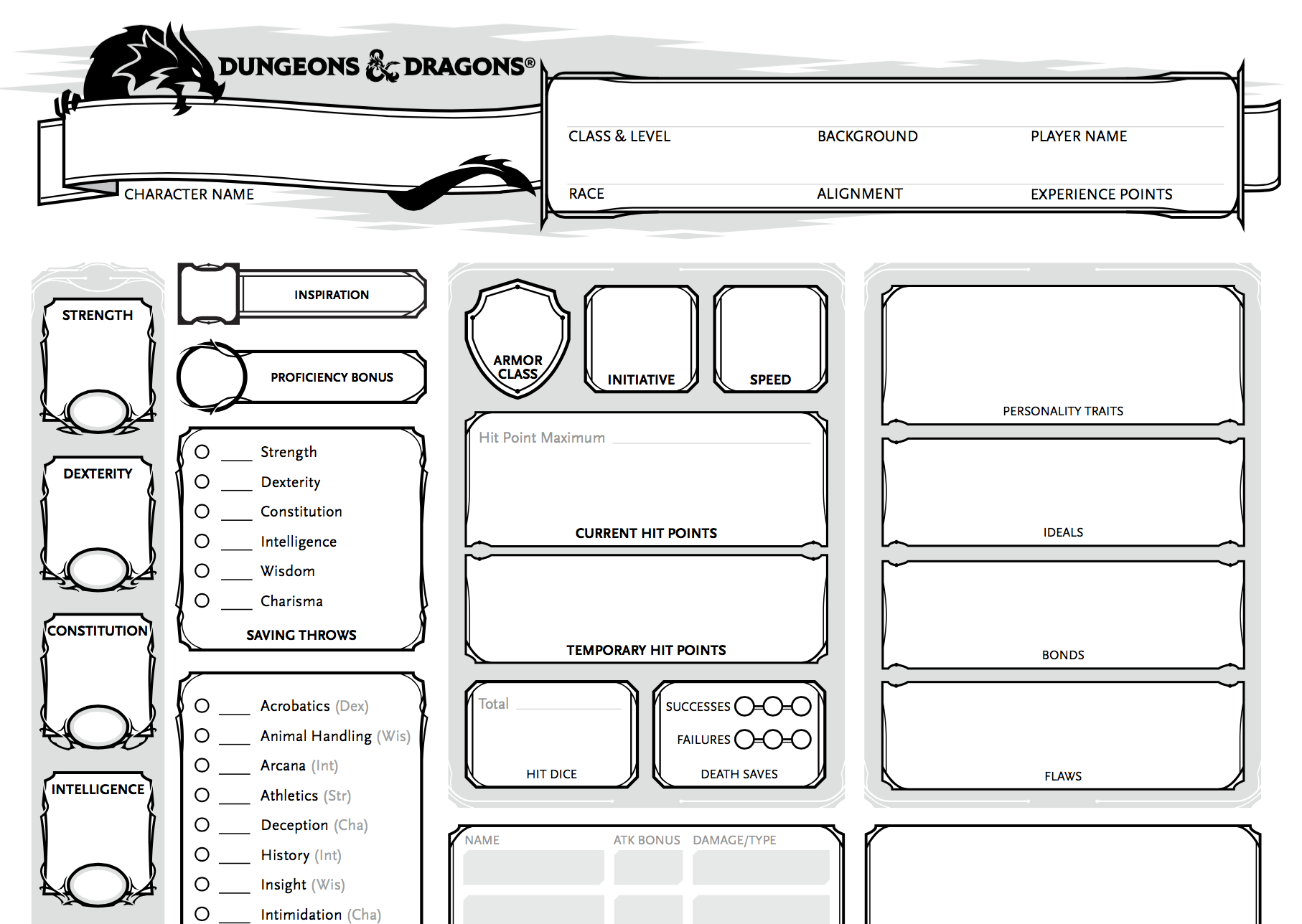
    The 5e character sheet. Just a tiny bit more streamlined than the Pathfinder one (below.)
    The 5e character sheet. Just a tiny bit more streamlined than the Pathfinder one (below.)

    With our gaming group, I sometimes think the rules get in the way of the game. A player can really enjoy making the most of a rule to decide how to behave – but as a new DM it can mean we stall out in the middle of a tense battle or a unique puzzle may lose its interest. None of us knows the rules so well that we can think story and let the rules flow.

    5e promises to fix that problem. On the web it seems like that’s the reason most people switch to it. But will the switch itself throw off our group? “That’s not how it worked in Pathfinder…” stalls the story just as much as any standard rules question. This almost feels like a economics question – which is more disrupting: the opportunity cost or the switching cost?

    Portion of the Pathfinder character sheet. More complicated - but more detailed.
    Portion of the Pathfinder character sheet. More complicated – but more detailed.
  • For my birthday, my parents gave me Mice and Mystics. It’s a role-playing-game-in-a-box where several adventurers have been turned into mice to escape the wrath of the evil Venestra. You battle against roaches and rats instead of owlbears and manticores.

    Unforunately the next-to-last tile had a tough encounter and we couldn’t keep our mice from being captured. We ran out of time for the chapter. But it was super fun and we’ll give it another try soon.

  • This is Part 3 in a series called “To Switch or Not To Switch” about whether or not my gaming group should switch to Dungeons and Dragons, 5th Edition, or stay with Pathfinder.


    Whichever gaming system we use, I’ve already determined that to be a better DM I’m willing to invest some money into the books and publications that accompany the system. What’s a little less obvious is how he return-on-investment will play out.

    Pathfinder has a wealth of material available, and a lot of it can be purchased bit by bit at lower price points. I can get a lot of homebrew value out of a Pathfinder Player Companion and those are usually about $8 – $12 on PDF, or $15 to get the print edition. One of those a month is plenty of information to keep my homebrew storyline going.

    Dungeons and Dragons Fifth Edition (5e) has less material available right now. It’s not been around long enough yet to expect that. But they do have adventure paths that will take a party from level 1 to level 15 that cost about $60. For our gaming group meeting biweekly, that’s probably a year’s worth of material at least (if we stick to it.) A campaign setting book is also due out this fall, so by the time we switch we could use that for a homebrew situation.

    But guess what? Pathfinder has adventure paths of similar length for about the same price – so we could still go that route if we wanted to use in adventure path.

    This makes me think that investment in books is pretty negligible. Each company keeps the price-point similar. Unless we know for certain that I’ll be homebrewing stories for years to come instead of using adventure paths and modules. In that case, the cheaper piecemeal Player Companions give Pathfinder the edge in my opinion.

  • This is Part 2 in a series called “To Switch or Not To Switch” about whether or not my gaming group should switch to Dungeons and Dragons, 5th Edition, or stay with Pathfinder.


    Our gaming group has a varied background when it comes to RPGs. We even enjoy it for different reasons – some are more calculating/mechanics-focused, some are driven more by story/character, and a couple of folks mostly like the social aspect of nerds gathering around a table, no matter what game gets played. This doesn’t bother me, but it does create some situations where one might lose the perspective of a fellow adventurer.

    In particular this comes up over rules. Many gamers online have praised 5th ed for its ease of keeping the game going, but I’ve never found the Pathfinder rules to be cumbersome. I find us getting each others way to be cumbersome, because we all have different experiences and confuse the rules a lot. Since I’m still a new DM, I don’t really have the knowledge base to take the “supreme leader” approach to rules in those times.

    Dungeon Master's Guide for Dungeons & Dragons 5th Edition
    Dungeon Master’s Guide for Dungeons & Dragons 5th Edition

    If we did the switch to 5th ed, we’d all be doing it together. The new rules would be a shared experience and we’d all be on the same page. I think we’d feel the ease of use as well, mostly because people will get back to basics on what is true of all these systems:

    1. The DM explains your current environment, conditions, and story
    2. You say what your character does
    3. The DM narrates what happens

    A lot of disruptions to the story fly out the window if everyone will stick to that core. If someone starts trying to do some Skill check or a really my mechanics-driven scheme, my best response as DM will likely be, “What do you want to do?” And if someone isn’t sure of the rules at all, the best response is the same. Once a player explains what they want in story terms, any rules system can be used to make it happen somehow.

    pathfinder core rulebook

    Right now the response to someone wanting to use a mechanic is along the lines of “Uhhh, Amber, Danny what do you think? Stealth and Acrobatics? Maybe just do a general dex?” Because while I pride myself on having prepared some great stories, I’m not a rule expert on Pathfinder at the moment. If we decide to stick with it I plan to read up and fix that problem – but I still fear situations where DM-by-committee accidentally happens.

    If we switch to 5th ed I think we’ll end up having a session that’s all rules and character creation – maybe a quick battle to chuck more dice. My hope being that session would develop a shared trust that any of us could DM and their judgment would be fair. Any time we argue rules later on, we can address our understanding of when we learned the rules together.

    The downside – it’s not really fun to learn new rules. I’ve outlined some troubles we face sometimes here, but it’s not like those rules discussion ever ruin a gaming session. We still kill the bad guy, move on with the story and level up. That’s a lot more fun than talking theoreticals and figuring out a new character sheet.

    But would that step back lead to two steps forward?

  • If you start a tweet with the letters
    DM
    it makes Twitter send a direct message instead of just tweeting.

    Very sorry to the twitter user with handle @is who (multiple times) received a direct message from me when I was trying to talking about being a Dungeon Master (DM) in the context of Dungeons and Dragons. Finally got the tweet to go through regularly though:

    https://twitter.com/alexjgustafson/status/635116325325676544

    ,
  • This is Part 1 in a series called “To Switch or Not To Switch” about whether or not my gaming group should switch to Dungeons and Dragons, 5th Edition, or stay with Pathfinder.


    Just started my rpg group on a homebrewed quest in Andoran, part of the Pathfinder universe. I’ve put a lot of thinking into the story and it’s exciting to get the adventurers on their way. Everyone seemed to buy into the hook and the random encounters on their first travel day proved a good introduction to the content.

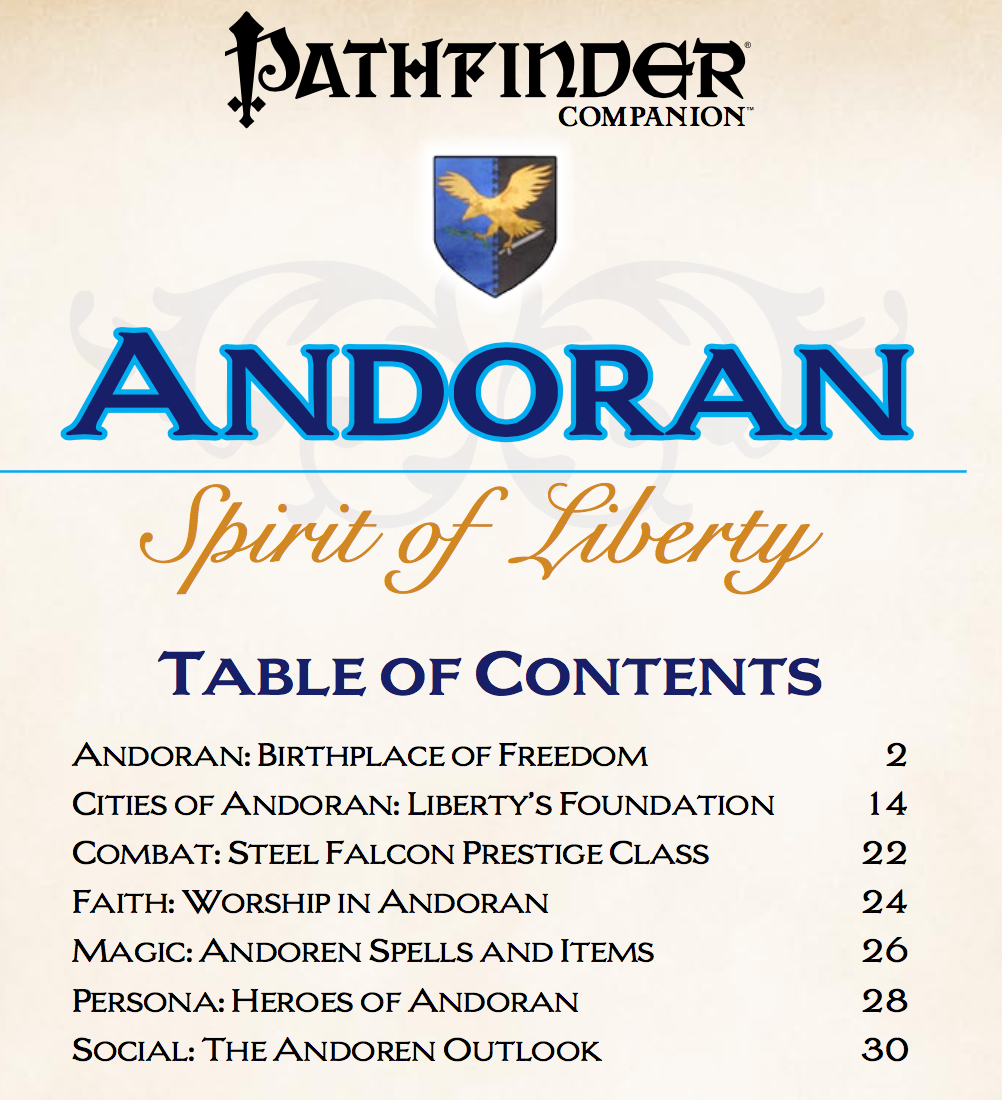
    Should this campaign prove successful a good part of it will be thanks to the information in the Pathfinder Companion, Andoran, Spirit of LibertyIt’s 30 pages of information that really brings the continent to life. Whereas an adventure lays out the story for adventurers to play out, this is the reference material to fill in the details. I’ll supply the story, but this guide helps me make the world fit together a lot better than I can do on my own.

    The table of contents may give you an idea of the material a Pathfinder Companion contains
    The table of contents may give you an idea of the material a Pathfinder Companion contains

    Writing this campaign has made me realize just how difficult world-building is. If you try to blank-slate homebrew everything, you’ve got your work cut out for you. But I find after a few minutes of studying this source material I can usually come up with a few hooks and a plot that will make the next couple sessions a lot of fun.

    One of my concerns about switching from Pathfinder to Dungeons and Dragons 5th Edition (5e) is that I’ve only recently discovered how much better a DM I am with source material, but the two systems publish that material with wildly different formats. Paizo publishes a new Pathfinder Companion every month, and there are years of back companions I can work with. Each one isn’t all that expensive and it’s enough that I can homebrew campaigns.

    D&D 5e really doesn’t have this kind of material yet. A source book called Sword Coast Adventurer’s Guide is due out in November 2015, and it’ll be about $40. In addition to that, 5e does have a few Adventure Paths ready – long form campaigns that will take a party of characters from Level 1 through Level 15 with one huge story.

    That kind of Adventure Path might work well for us! I would do a lot less homebrewing and more module studying, and that’s how I got my start as dungeon master. Pathfinder offers this kind material as well – but once again they offer it not only as big books but also in monthly doses I can subscribe (and not subscribe) as I like.

    Both seem stable – but clearly Pathfinder has more room for options. 5e has fewer options, but may actually be what I need instead of help with world-building as I go. It’s a tough call.

    My heroes still have a ways to go in this quest, but once they reach the end I think we’ll have an epic enough moment our group can take a pause and decide whether we want to stick with Pathfinder or make the switch to 5e. I’ll make few more posts on my thoughts on the switch during that time.

  • A wonderful thing you can do to enhance the gaming experience is to play music appropriate for the game’s setting. This is true of both board games and role playing games!

    Matt Mercer, the dungeon master for Geek and Sundry’s twitch show Critical Role uses a masterful selection of music to set their environments and situations. Critical Role music selections come from a couple of sources:

    • Incompetech – Royalty-free music by Kevin MacLeod
    • Plate Mail Games – high quality professional background loops for a variety of genres

    But if you’re looking for the Critical Role theme song, you won’t find theme there. That was written by Jason Charles Miller, and I believe you can download it on iTunes.

    Another great source for gaming environments is Tabletop Audio. Some of these loops are ambience and sound effects, some of them are movie-score like compositions. But they’re all free to use at home! If you do use them a lot though, it’s friendly and good of you to contribute to the creator’s Patreon account.

  • In our primary roleplaying campaign I’ve been DMing. But in addition to our standing game, Amber has decided to start DMing some one-off games every once and a while. Instead of the same party of adventurers travelling together through thick and thin, in these one-offs the party will be made up of any folks who can play that week. We’ll work through one short quest or dungeon crawl that can be wrapped up in one session so that there’s no scheduling a day where everyone has to come back.

    For our first one-off we have a lot of new folks joining us. It’s weird because (aside from Ber) I’ll know more about what’s going on than anyone. For that reason, Ber has asked me to play a spellcaster since managing spells is harder on new folks and it’ll help balance the party if I make sure we have at least one. pathfinder core rulebook

    We’re all going to play second-level characters and we’ll be using the Pathfinder game system. Here’s a few character ideas I thought of:

    • Human Inquisitor who worships Gozreh
    • Half-Orc Bard that runs a travelling troupe
    • “Tower” Elf Wizard

    I only learned of the Inquisitor class tonight, but loved the idea. It’s kinda like being a cleric in that you serve your deity, but you’re willing to bend the rules of the church to fight the church’s enemies. But since we’re only starting at 2nd-level, the Inquisitor doesn’t really get many spells per day so maybe it’s not the right fit.

    The half-orc bard is blatantly stolen from Scanlan Shorthalt’s backstory on Critical Role. I wouldn’t name him Dr. Dranzel or mention Scanlan, but that was definitely the inspiration. This is probably what I’ll end up playing because I always sing in real life. Being a bard is in my blood.

    A ‘tower elf’ is one of the racial sub-types for elves. Basically they’re elves that study wizardry in the time honored-tradition of locking themselves up in a tower full of spellbooks along with other elves doing the same. You gain some advantages when it comes to the arcane, but you’re also a weirdo recluse only now going out into the world — so there ya go.

  • When you’re in a role-playing game, sometimes characters have more knowledge or perception of their whereabouts than the other members of their party. A good way for a dungeon master to give this information to the player is by passing notes.

    In Titansgrave, we’ve seen this happen a couple times. Most recently in chapter 5, “Staff of Forlorn Hope,” when Kiliel (played by Alison Haislip) can see more about Mr. Voss than the others can. Her reaction nails why this story-telling tactic is awesome.

    It’s exciting because it empowers the player. They get the information and they get to choose what to do with it, instead of being subject to the DM’s narration of events.

    For the purposes of Titansgrave, it’s doubly effective because each of the players have secrets they’re hiding from the others. Using note-passing during more common instances like Kiliel’s actually makes it more normal when the note-passing is crucial to those secrets. I really hope a note-pass makes or breaks the climax of one of these adventures, because Wil has used them skillfully.