One of the cool things WordPress.com handles is media embeds. Instead of messing around with a bunch of embed codes, your WordPress.com site is setup to use oEmbed. This means if you want to share something like a YouTube video, you can just put the YouTube video’s link into your post and we handle the rest.
The tricky thing about embeds though is they can be tough to style if you want to do something specific with them in your post. With some services WordPress.com also provides shortcodes, but those don’t give you full design reign either.
The most common request I see is to center up an embed with a post or page’s body. While it’s hard to apply styles to the embed itself, we can definitely apply styles to an HTML element that surrounds the embed, like a div.
Using CSS Flexbox, it’s then pretty easy to center up that embed. Here’s a video:
The code I use that in video is the following:
<div style="display:flex;justify-content:center;">

// Link to embeddable content here

</div>
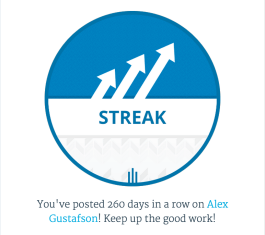
There were two daily streaks I’ve been managing for months. One was posting daily here on my blog, and the other was hacking daily on Ingress. WordPress.com gives you a cool little notification every time you post if you’re on a posting a streak. Ingress rewards you with a badge, an award they call “Sojourner.”
In March both of these streaks started. In December, both of them ended.
The Sojourner Streak
‘Hacking’ is the primary game mechanic of Ingress. The game is augmented reality, meaning you play on your phone or tablet but to move around in the game you must move around in real life. Objects of interest in real life like art, historical markers, and churches are ‘portals’ on your phone. If you’re within range of a portal you can hack it and earn some loot.
Ingress Sojourner Badge at 274 days
In March 2015, Ingress got a new badge called Sojourner. To earn the badge an Ingress agent must hack at least one portal within 24 hours of their last hack. Essentially, it’s a nudge for a daily streak — it’d be odd for someone to play Ingress and not be hacking portals; play Ingress everyday and earn your badge. But the specifics of Sojourner are more than play Ingress everyday, it’s play ‘within 24 hours of your last hack.’
Imagine your last hack was at 9am Monday on your way into work, then you didn’t play the rest of your day. Then it just so happens you arrive late to work on Tuesday, hacking at 9:15am. You’re out of luck for Sojourner because 9:15 am Tuesday is more than 24 hours after 9am Monday, even though you hacked everyday. Some folks around the internet are reporting there is more buffer than this built-in because Sojourners weren’t ending when they expected, but I’ve not seen anyone replicating that buffer reliably.
A few days after the Sojourner announcement I decided this was a badge I could get behind. At the time I was playing for 30 minutes minimum everyday, and I have several portals less than 5 minutes walk from my home. There are lots of hacking opportunities around my other local haunts as well. I setup a recurring todo in my Wunderlist for my Sojourner hack. I installed a separate application to show a 24-hour timer since my last hack. This became a pretty easy badge: never let the time hit zero and I’ll make it all the way.
And for 274 days, it was easy. There were a couple close calls, but for the most part it didn’t require attention or thought. I would do at least a hack in the morning and a hack in the evening and it was just a part of my daily habits. I’d have days where I’d play more Ingress, but everyday I’d at least get my Sojourner hack done.
The streak ended on Sunday, December 6th, because I wasn’t thinking about Ingress at all. My mind was swimming with nothing but our Dungeons & Dragons group. That focused attention really paid off. Finishing our campaign on a high note made for a great day of writing and preparation, and then amazing gameplay from the crew. But as we were cleaning up late that evening it dawned on me that I had not stepped outside all day. I hadn’t checked my phone all day; it was still hooked up to the charger from the night before. No number of notifications and reminders and systems would’ve saved me because my attention was totally devoted elsewhere. The Sojourner streak had been dead for nearly 8 hours and there was nothing to do about it.
And I was okay with that. I’m still okay with that.
The Blogging Streak
The first post of what became eight months of daily blogging was published on March 26th, 2015. It was my wrap-up of WordCamp Dayton that happened about a week before. WordPress.com had started sending you an acheivement notification if you had a daily streak going on an individual blog, and Matt was pretty proud of his streak. With the recent excitement from WordCamp I decided to be more deliberate with my blogging.
Notification for 260-day posting streak
Once I committed to blogging daily the majority of posts were pretty simple. Their value wasn’t much to anyone besides my immediate friends and family. But I also became more likely to work on that big post that takes a lot of time and really wanted to share. Those posts may only happen every other week, but before I started the daily blogging they weren’t happening at all.
This extended period of working on my blog everyday helped me understand something that we hear from our users all the time. Blogging is helpful force in one’s life. Writing for the public to read is almost therapeutic, and it certainly helps one become a better communicator. Any time spent working on my blog felt like a net-positive, and I don’t feel that way about how I contribute to other social parts of the web. Blogging doesn’t feel like timewasting the same way scrolling through Twitter does.
Two hundred sixty days is a long streak. About a month ago I posted that I was having hard time keeping up. Thinking up posts is getting harder, and that’s mostly because I’ve been spending most of my time trying to get things off my plate. Finishing up work projects and doing chores isn’t really great blog fodder, but it’s the best thing for me to be doing since we expect the baby any day now. That’s not what ended the streak though.
In fact, the day my streak ended was a very exciting one for me. My creative juices were flowing and I felt good about everything. I could’ve very well cranked out three or four posts that night had it crossed my mind. It just didn’t. I did a full day’s work, I worked on my theme while watching Jessica Jones on Netflix with Amber, then stayed up late reading The Martian by Andy Weir. I slept well and woke up Saturday morning to the realization that Friday had no scheduled posts, and I didn’t so much as think about blogging all day.
It’s especially awesome that this is what greeted me when I double-checked my site to see if I had a scheduled post on Friday:
You said it, Alton.
Lessons Learned
The biggest danger to my consistency is my excitement. These two streaks were something I had no problems with developing on a daily basis for two-thirds of a year. I worked around plenty of external obstacles and chaotic, unexpected interruptions during that time – but those never broke my daily habits. It was my own interests that defeated me. Shiny objects in my peripheral vision grabbing my attention.
Thankfully the world doesn’t end when any streak breaks. My blog is still here and all those posts are still published. My drafts are still waiting there turn. Those Ingress portals haven’t moved and I can hack any day I want. And the things I did instead weren’t bad uses of time by any means. Maintaining a streak shouldn’t cost you an interesting life, or even an interesting day.
But it’s worth noting that for the most part – my systems worked. I’ve figured out how make myself do something everyday if I want it to be done. And it took these lessons to figure out where the system will fail.
Going Forward
Ingress has already started taking a back seat. I have a Guardian portal I’m recharging (which can be done from home) and I still play when I can, but it’s mostly when I walk the dog. For a fun little cell phone game, that seems like enough.
Blogging will continue. You’re reading this post, right? But I’m only going to schedule/plan on posting on Mondays and Fridays. Anything else is gravy and I’m sure they’ll still happen, but I don’t see another daily streak as something I want to strive for. I’m also considering starting a second blog and doing a more rigorous posting schedule there, and reserving my personal blog here more for on-a-whim updates.
I’ve had some recent successes with fitness. Maybe my daily habit tracking will switch to obsessing with that instead. Pushups and and steps replacing blog posts and hacks.
I love Sedaris’ writing and I remember reading When You Are Engulfed in Flames in a single day. But this article seemed over the top even for him. How someone could get this obsessed over such a little nudge seemed definitely a work of fiction.
It may still be fictional in parts, I honestly don’t know, but I do now believe its possible to be truth. Automattic decided to give each Automattician a free fitbit this year, and I mine just arrived in the mail on Friday evening. All weekend it was at the front my mind.
A certain amount of this is just that it’s new, I’m sure. Gadgets that aren’t interesting when they’re new aren’t really marketable. But this feels different than when I got my Nexus 5 (that I still go on and on about how much I love it) or when I switched from Windows to Mac. Those are still tools to make me happy.
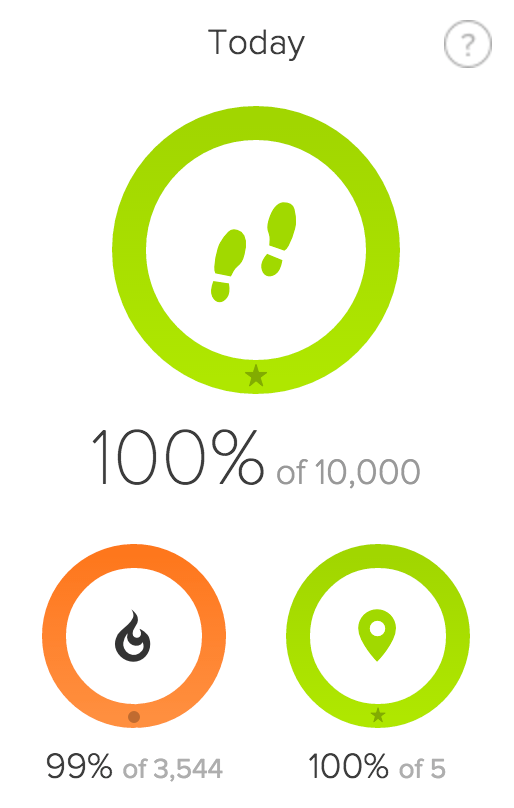
I want to make the fitbit happy. I drank water not because I felt thirst but because the fitbit said “Kinda thirsty over here!” Literally, that was a message on the app. Sure, once I started gulping down the water I realized how dehydrated I was, but the making the fitbit stats nicer was the trigger.
It’s a silly little game on my wrist, but I think I’m starting to like it.
Another new resource I learned about at the November Louisville WordPress Meetup was a community that’s growing at Louisville.io. There you’ll find a directory of local tech conferences and meetup groups, and you can also become a member of the Louisville.io Slack team.
If you decide to join the Louisville.io Slack, feel free to ping me in the #front-end or #wordpress channels!
Been thinking a lot recently about how my child may experience life differently than their peers. My coworker, Kraft, has a great post on that topic:
What will the children of Automatticians and other remote worker be like when they enter into the work force? Will they accept the typical working experience or will they balk at the assumption that work is done best from a central location? Will they struggle to enter the work force when they expect to be able to be at home for lunch every day, or available to step out of the office for five minutes to hold a baby like a generation ago people taking a smoke break.
My employer, Automattic, is a fully-distributed company; meaning that my colleagues are hired regardless of their location. You can work from home, from coffee shops, from an RV that’s currently on the move, or you can expense fees for a coworking place. (By the way, we’re always hiring.)
Today I learned of another company that works remotely, Baremetrics. I wanted to share their rules for Self-Care in their remote environements:
Have set work hours and stick to them.
Exercise every single day.
Alternate between sitting and standing.
Eat well.
Take frequent breaks.
Having worked remotely for a year, I will vouch that these are very good rules. I’m only now starting to figure out the true value of some of these.
Wunderlist has been my to-do application for several months. I like it a lot and my wife has put up with it, so we’ll probably keep using it for the foreseeable future. One feature that I especially make use of is recurring events.
I’m one of those people that uses a full to-do list as motivation to keep the day moving. Left to my own devices I can sit quietly in my chair and let hours float by while I just think. There’s lots of thinking to do. But when I have a full list, it’s a lot less likely I’ll waste my time this way.
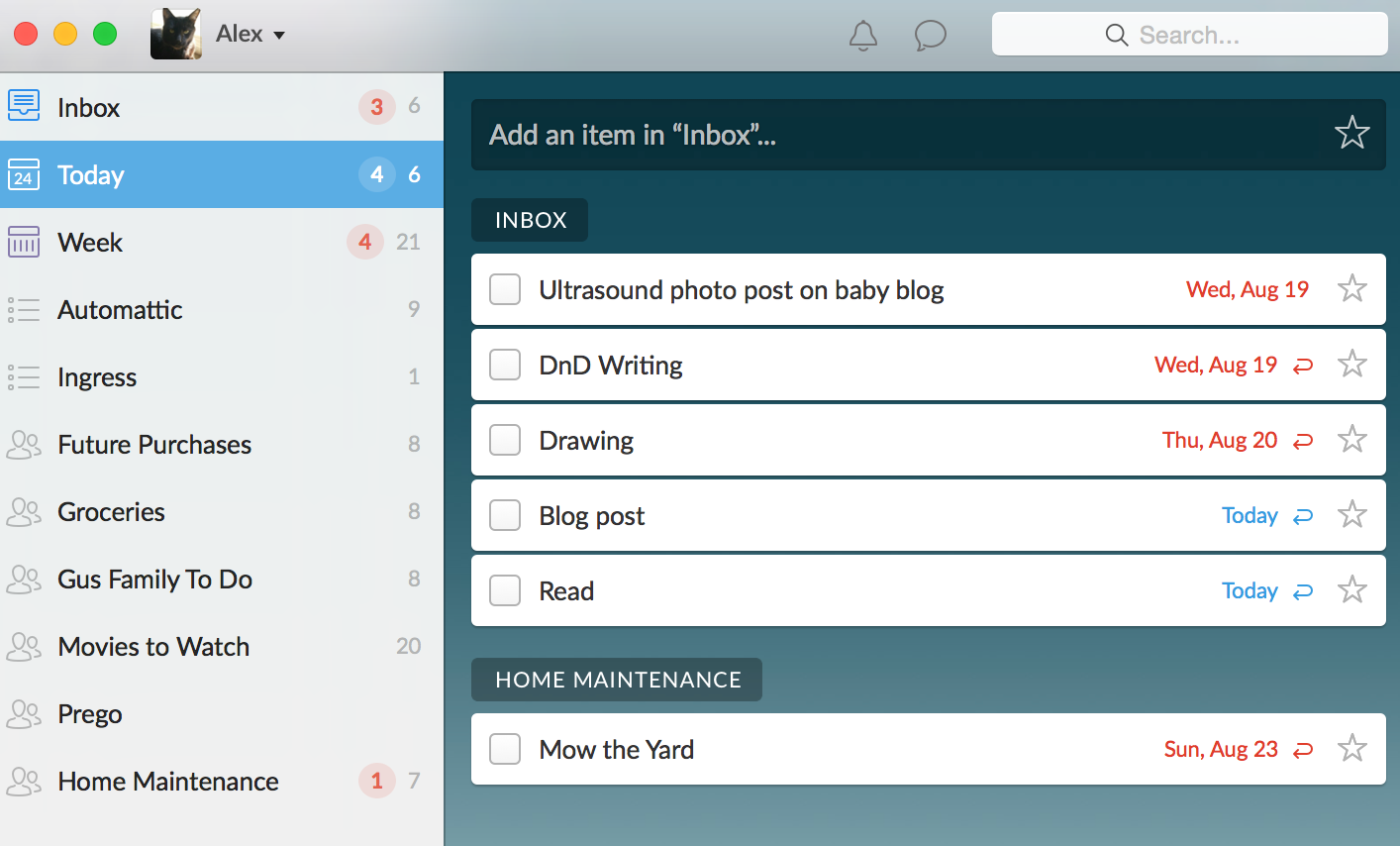
The end result is that I add a due date to almost everything in my Wunderlist so that I can stare at the “Today” smart list instead of into my own mind. The other result is that a lot of my recurring events will go red (ie, late) and stay red for great lengths of time.
At the end of the day, a bunch of red tasks still to be done.
For instance, learning to draw is a hobby right now. I want to do a little bit everyday, but it’s much lower priority than finishing my work tasks or chores at home. So it hasn’t happened in almost a week. Mowing the yard is important, but I hate doing it and I’m only willing to bother under the right weather conditions and time. So it will probably stay red all the way up until there’s a jungle in my back yard.
The unfortunate result of these red items is guilt. I can work very hard all day, cross lots of items off my list, and still feel like I’m not getting traction.
At what point do you declare to-do bankruptcy to get rid of all this to-do debt? Answers and any other to-do ideas are welcome in the comments.
If you start a tweet with the letters DM
it makes Twitter send a direct message instead of just tweeting.
Very sorry to the twitter user with handle @is who (multiple times) received a direct message from me when I was trying to talking about being a Dungeon Master (DM) in the context of Dungeons and Dragons. Finally got the tweet to go through regularly though:
I had no idea that “.io” referred to a place and not just “input/output.” Learned a lot from this one.
[…] .io is also a place: a country-code top-level domain, or ccTLD, which refers to a particular place on the Earth’s surface. In this case, that place is the British Indian Ocean Territory, a remote but strategically-important scattering of islands in the middle of the Indian Ocean, also known as the Chagos Archipelago.
There are a handful of networked devices I require to do my job and be a participant in the modern world. Outside of that, an Adama approach seems prudent.
Except for the computers I need in my life, I want my technology to be as dumb as possible. Once a device is networked, all bets are off.
Does your refrigerator, stove, or automobile really need a networked computer inside of it? Do you really want a dedicated, networked device with a microphone always listening for your commands inside of your home?
Quite possibly the best reference to Battlestar Galactica I’ve ever seen in real life. The Galactica had many computers for a variety of tasks, but none of them were networked because it left them too susceptible to Cylon attack.
Paul’s got a good head on his shoulders, and I’m proud to work with him.


 Alex "Gus" Gustafson