• My favorite thing about Seth Godin is he knows how to play the changes. The melodies are always a little different, but the harmonies, structure, and tone we expect of his work find the realm where he does best. Make a ruckus, do the real work, and if you’re scared that’s a great compass for where you should go.

    The Icarus Deception fits right into Seth’s repertoire. A full book of content, but chunked up into essays. Once you hit something that resonates, it’s better to put the book down and go act on it instead of staying in reading mode. And it’s a book that will make you want to get something done for sure.

    We’ve all been told the story of Icarus flying too close to the sun, but for some reason we’re not all told the other warning: don’t fly too low, or the sea may drag you down. Right now, there is so much opportunity that not enough are aiming to the skies. That’s what Seth wants to solve in this book.
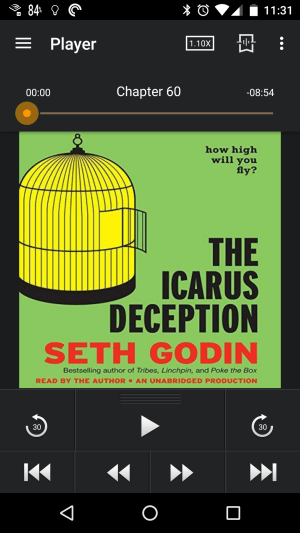
    Screenshot_20170115-113119.png
    The Icarus Deception by Seth Godin on Audible.

    Since Linchpin in 2010, I’ve followed Seth. He caught me right when I decided I wasn’t my best work wouldn’t be as a musician. I needed help to think about my new path, and Linchpin was the start of it. I knew whatever was coming next, it would happen because I made myself ready for it. Trusting on my high school GPA or my bachelor’s degree to get me anywhere was foolish at best, and life-threatening at worst.

    Icarus came out two years later, but it was always on my “to read” list instead of “reading.” After Seth’s excellent episode on the Tim Ferriss podcast, I decided to pick up where I left off. When I noticed he read the audiobook himself, that also seemed like a good fit. He’s a speaker and teacher as much as he is an author, and I can’t get enough of hearing him talk.

    It’s hard to get through the book, because so many times he’ll say something great that makes you want to go make some art instead. To start that project you’ve been too scared to try. To make your mark at your job. But then it’s also easy to get through the book; it’s refreshing, it’s inspiring, and you want more of it when it’s done.

    A good one from Seth, and I’d ask for an encore too.


    The Icarus Deception by Seth Godin, part of my 2017 Reading

    Audible | Goodreads | Wikipedia

    http://sethgodin.com/sg/books.asp

  • Mihály Csíkszentmihályi was one the early psychologists to study positive psychology. This book is an explanation of his years of findings in the subject, all put into practical terms for everyone instead of academics.

    The premise of the book is that humans are happier overall when they spend more of their time in a state of “flow.” Precisely defining that state is a good portion of the book; for the sake of a brief blog post it can be helpful to think of it with the following visual aid.

    flow-diagram.png

    The situations that create a state of flow are when the challenge of the situation matches up perfectly with an achievement in our skill. Too easy a challenge on something you’re competent in leads to boredom. A high challenge with no training? Anxiety. High challenges in something you’re very skilled? Flow.

    While in flow, our experiences become “autotelic.” We do the thing for the thing’s sake. We master our chess match only because we want to. We climb the mountain because it’s there. Not out of boredom or worry, but because it matches with what we’re skilled to do and it’s a challenge to overcome.

    If you’ve not already seen it, you should watch this TED talk before reading the book.

    I’ve seen this video more than once and I still found value from the book. But if you watch this and say “meh,” I think you’ll not enjoy it or find it useful.

    Once you agree that this flow state can bring about a more systemic joy to your life, the question begins to turn to how you can and can’t control bringing more flow states to your life. Not every job lends itself well to flow, but you may not be so quick to rule yours out. The errands and chores of family life may be boring to you in some ways, but changing your perspective and the system of those actions might help you find flow in commonplace activities.

    img_20170112_205318.jpg
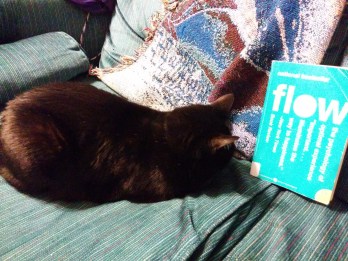
    “Flow” in paperback with avid reader cat, Bagheera.

    I’m working through a lot of issues right now. Having a young family and managing a career have both tested me a great deal on their own; combined I’m often amazed I’m still standing. But some notions from this book really strike a chord with me. Finding the situations that I can turn into a flow state are worth my while, and I think it an obtainable goal for many hours of my day that currently tend to land in boredom, apathy, or anxiety.

    Such systemic changes would lead to good things, I think.


    Flow by Mihály Csíkszentmihályi, part of my 2017 Reading

    Amazon | Goodreads | Wikipedia

  • Scalzi is so good at world building. I went into this book cold. All I knew was Scalzi wrote it and Wil Wheaton did the audiobook narration.

    Quickly you’re thrown into a near-future world altered by contagious disease and the technology that helps to ease its effects. Millions of people in the near future have “Haden’s Syndrome,” which most often leads to death or lock in.

    Technology progresses quickly to help aid people with the disease, who become referred to as “Hadens.”  It’s as if having the ailment is becoming another race. Those who are locked in can remotely control “Threeps.” Named after C-3PO from Star Wars, Threeps are machines that allow Hadens to walk around their neighborhoods, go to work, or play sports. All the while, their human body remains in a medical cradle at their home.

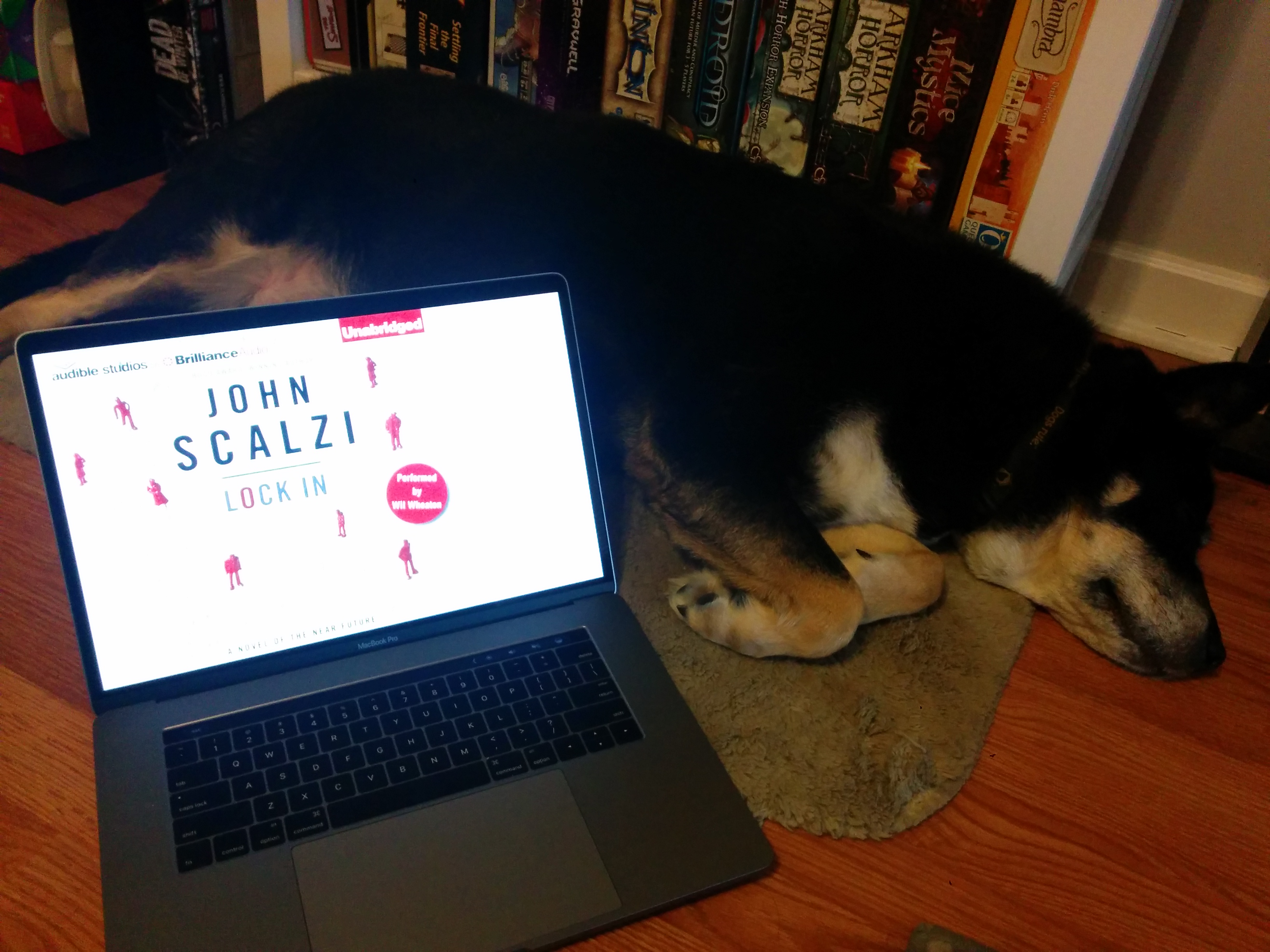
    Laptop displaying audiobook cover art for Lock In next to a sleeping dog.
    Lock In’s audiobook cover art, with avid listener dog, Nada.

    The plot of Lock In is a police procedural, like an episode of Law & Order. Our narrator is a Haden and our story is his first week on the job as an FBI agent. Going too far into the details would certainly spoil,so I’ll leave that be in case you enjoy police procedurals.

    It’s not a great story. It falls for the science fiction trap of solving made up problems with made up solutions without connecting enough to today’s humanity. Scalzi performs that connection so well in the Old Man’s War series, it hurts to see it fall short here.

    The world though, is superb. I love the political undertones that motivate so many of the characters, providing depth. Threeps and Integrators (spoiler) are interesting enough that I want to read other stories where such a sudden technological change has consequences we’ve not yet predicted. I think it can be done without a technobabble  resolution. We can expect at least one more novel in this universe, Head On, and I’ll read it even though Lock In was a letdown to me.

    I enjoyed this in Audiobook format via Audible, read by Wil Wheaton. The production was great and I’d recommend that version as well if you want to read this one.


    Lock In by John Scalzi, part of my 2017 Reading

    Audible | Goodreads | Wikipedia

    http://whatever.scalzi.com/about/books-by-john-scalzi/

  • “God help us, we’re in the hands of engineers.”
    Dr. Ian Malcom in Jurassic Park (1993)

    Ber and I watched Jurassic Park the other night and this may have been the first time I really heard this line from Dr. Malcom, played by Jeff Goldblum.

    The chaos-obsessed man becomes horrified at the notion of an automated car guiding them through the park. And this is before anything bad happens!

    Having worked in software long enough, this is now really funny to me.

  • Ber and I hadn’t been so excited for a night out in a long time. Babysitter lined up and nerd cards at the ready, we raced to the fancy recliner seats to watch Rogue One: A Star Wars Story.

    Spoilers ahead.

    It’s like someone put together a role-playing game one-shot and in a surprise twist used the Star Wars system instead of D&D. “So a blind monk, his fighter friend, two rogues, a warforged and a pilot NPC are going on a linear quest.” Tell me I’m wrong. (I’m not wrong.)

    And that’s not really a problem, I love D&D one-shots. But what it means is that you really can’t think to far into it. You need to put in your effort of enjoying the movie and it’ll be a freaking great time. That’s what I did.

    If you’d rather hear the drag-it-out nitpicking, I recommend Hello Internet’s Rogue One Star Wars Christmas Special. What I want to provide is the optimist experience.

    It felt dark, like Empire. But they ended with just enough a reminder that the good guys will win the next movie that it still felt like an adventure instead of a tragedy. Darth Vader’s fight sequence was worth the price of admission. CGI Tarkin was shocking not the worst CGI in the Star Wars universe (I’m looking at you Jabba the Hut in A New Hope: Special Edition.)

    Alan Tudyk was so good as K-2SO I didn’t even realize it was him until after the fact. And really, his death was the only one that kinda hurt while I watched it. Loved that droid. Most of the other rebels were kinda jerks. Like everyone at that D&D one-shot cared way too much about the loot.

    Chirrut and Baze were awesome. Leaving the movie Ber said she wants us to play a monk/fighter buddy duo just like them whenever we get to play D&D together. I would enjoy that thoroughly. I do think their talents were wasted as infantry on a beach, though. Maybe some novel will come out about them being badasses on Jedha before it got blown up.

    Most importantly, they paced the movie to be exciting moment-to-moment. While the whole story seems kind of winding in retrospect, whatever was happening at the time seemed pretty cool and Star Wars-y. Unlike the prequels, where sure the overall timeline was respected but it was boring as all get out.

    That’s what I feel about this movie: it’s entertaining as a Star Wars movie should be. I’ll rewatch it and not feel ashamed. I’ll discuss it and point at all my favorite bits. But I think the story it tells could’ve gone so many other ways. It’s best to just be happy it wasn’t bad.

  • This blog had been using Hew for nearly a year. With the new domain name in place, I figured now is as good a time as any to update.

    alexjgustafson.blog is now running on Attache.

  • Thank goodness I have a lovely, understanding wife. I’ve basically been a ball of grump all afternoon and she shouldn’t have to put up with that. But she did. I’m still married; so I’ve got that going for me.

  • One of my favorite literary devices is an unreliable narrator. The Curious Incident of the Dog in the Night-Time turns that notion on its head by providing a most truthful narrator: a teenage boy with an autism spectrum condition. The narrator, Christopher, is mentally incapable of lying (though he has a talent for noting loopholes) and therefore presents his experiences as wholly accurate accounts. But quickly the reader learns that even such pure truth is filtered by the person’s understanding of the events.

    In my case, I was a listener. On our long drive to Arkansas for Thanksgiving, Ber and I got several audiobooks from the library to help things along. This is actually the only one we listened to all the way through as we would normally turn the books off when the baby fell asleep.

    nada-curious-incident.jpg
    Avid listener dog, Nada. The Curious Incident of the Dog in the Night-Time on audiobook.

    The interesting narrator holds most of the weight of the book, but that seems enough with the skilled design of its plot. Just enough happens for Christopher to react to that any amount of unexpected twists or secondary storyline would be fluff; a distraction from the character we care about.

    One line (bolded below within a larger quote for context) I enjoyed I keep coming back to for nearly a month now:

    And Siobhan says people go on holidays to see new things and relax, but it wouldn’t make me relaxed and you can see new things by looking at earth under a microscope or drawing the shape of the solid made when 3 circular rods of equal thickness intersect at right angles. And I think that there are so many things just in one house that it would take years to think about all of them properly. And also, a thing is interesting because of thinking about it and not because of it being new.

    As a person who is most happy when left alone to do nothing other than think through whatever is in my head – yeah, I agree.

    I also loved this book because it had my five-billionth reference to the Monty Hall problem within like one week. Other ones including Numberphile (via my chronological listen of Hello Internet) and Back to Work. So when the main character explained it so easily I actually knew the answer too. I also love that Haddon has this funny webpage about that bit from the book. It’s like the law of Monty Hall: make something about the Monty Hall problem and everyone will email you to tell you you’re wrong.

    It’s a well-executed book with an interesting premise. Would recommend it to anyone in book or audiobook form.


    The Curious Incident of the Dog in the Night-Time by Mark Haddon, part of my 2016 Reading

    Amazon | Goodreads | Wikipedia

    www.markhaddon.com