
-
-
Made it to my parents’ house for a visit. Hope my cat doesn’t find out I’m ‘cheating’ on him.

—
-
I enjoyed my Titansgrave wallpaper for a while. But Titansgrave Season 1 is over and it’s time for something new.
I’m now using “Poetry” from this collection of subtle WordPress wallpapers.

-
This is Part 3 in a series called “To Switch or Not To Switch” about whether or not my gaming group should switch to Dungeons and Dragons, 5th Edition, or stay with Pathfinder.
Whichever gaming system we use, I’ve already determined that to be a better DM I’m willing to invest some money into the books and publications that accompany the system. What’s a little less obvious is how he return-on-investment will play out.
Pathfinder has a wealth of material available, and a lot of it can be purchased bit by bit at lower price points. I can get a lot of homebrew value out of a Pathfinder Player Companion and those are usually about $8 – $12 on PDF, or $15 to get the print edition. One of those a month is plenty of information to keep my homebrew storyline going.
Dungeons and Dragons Fifth Edition (5e) has less material available right now. It’s not been around long enough yet to expect that. But they do have adventure paths that will take a party from level 1 to level 15 that cost about $60. For our gaming group meeting biweekly, that’s probably a year’s worth of material at least (if we stick to it.) A campaign setting book is also due out this fall, so by the time we switch we could use that for a homebrew situation.
But guess what? Pathfinder has adventure paths of similar length for about the same price – so we could still go that route if we wanted to use in adventure path.
This makes me think that investment in books is pretty negligible. Each company keeps the price-point similar. Unless we know for certain that I’ll be homebrewing stories for years to come instead of using adventure paths and modules. In that case, the cheaper piecemeal Player Companions give Pathfinder the edge in my opinion.
—
-
One of my favorite bloggers is Seth Godin.
If you read Seth enough, you’ll find he repeats some of the same ideas a lot. It’s become some ideas are worth repeating.
Have you ever read a post and thought “I need to come back to this again a few more times to let it sink in.”
Seth’s blog has that pre-installed.
What’s a topic you need to repeat for your readers?
—
-
My colleague, Bryan Villarin, let me know on Slack last night that he was going to post a response to my “to-do debt” problem.
I wasn’t expecting it to come so soon or with such detail, but it’s here! If you’re curious about the David Allen Getting Things Done approach to solving my problem, read on:
—
-
I’m a terrible pool player. Wonder if I’d be a decent Loop player?
Read more about the game (or play a digital version!) at the creator’s website:
—
-
Wunderlist has been my to-do application for several months. I like it a lot and my wife has put up with it, so we’ll probably keep using it for the foreseeable future. One feature that I especially make use of is recurring events.
I’m one of those people that uses a full to-do list as motivation to keep the day moving. Left to my own devices I can sit quietly in my chair and let hours float by while I just think. There’s lots of thinking to do. But when I have a full list, it’s a lot less likely I’ll waste my time this way.
The end result is that I add a due date to almost everything in my Wunderlist so that I can stare at the “Today” smart list instead of into my own mind. The other result is that a lot of my recurring events will go red (ie, late) and stay red for great lengths of time.

At the end of the day, a bunch of red tasks still to be done. For instance, learning to draw is a hobby right now. I want to do a little bit everyday, but it’s much lower priority than finishing my work tasks or chores at home. So it hasn’t happened in almost a week. Mowing the yard is important, but I hate doing it and I’m only willing to bother under the right weather conditions and time. So it will probably stay red all the way up until there’s a jungle in my back yard.
The unfortunate result of these red items is guilt. I can work very hard all day, cross lots of items off my list, and still feel like I’m not getting traction.
At what point do you declare to-do bankruptcy to get rid of all this to-do debt? Answers and any other to-do ideas are welcome in the comments.
-
A state of flow is always something to be desired. How you get there is a path you’ll need to discover on your own. But perhaps your path will look something like mine.
Put headphones on to keep the rest of the room out. Turn on some music and put it on loop – something instrumental or maybe an album you’ve heard a million times. Nothing new or interesting that will pull your focus. Keep the volume down lower than you’d expect.
Turn your phone to silent for the next two hours. More if you like, but two hours is a good start. Set all your communication to away.
You’re still there, but you won’t get nearly as many alerts, boops, or pings. It’s fake away.
Next – do just the first one. Just the first email, the first sentence, the first thing that you’re about to do a lot of.
And keep going. Let the flow take you away. Just fake away.
—
-
In college I first started reading self-help books. Classic stuff like Think and Grow Rich by Napoleon Hill and How to Win Friends and Influence People by Dale Carnegie. It was also during this time that I became a little obsessed with success. I still focus a lot on how to live a successful life but my definition of that success has changed a lot. Books like those, that celebrate the charismatic salesman, have remained popular for a century in large part because of how Americans find extroversion to be so appealing.
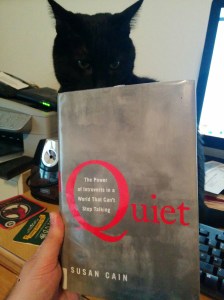
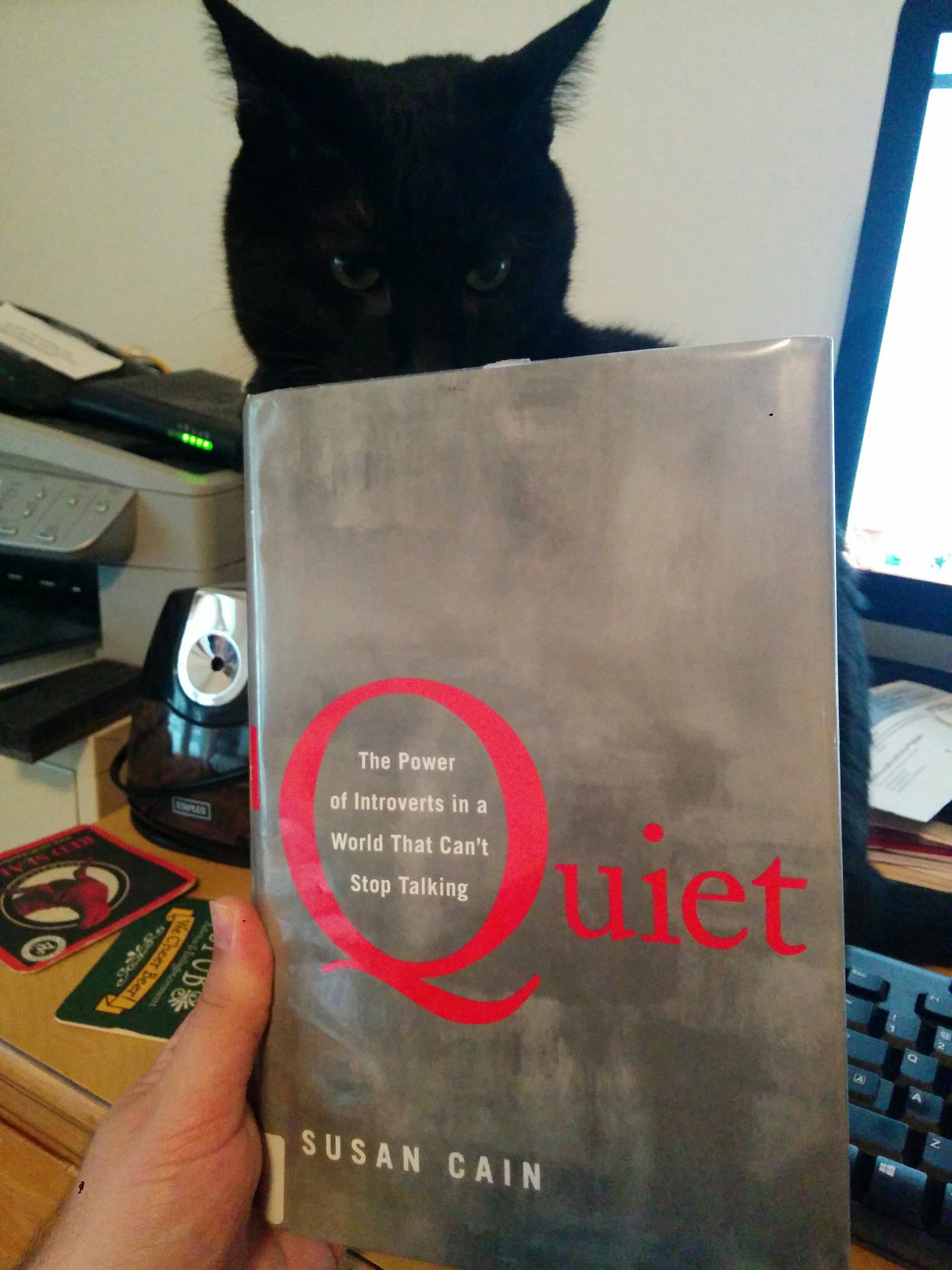
Quiet, in hardcover with avid reader cat, Bagheera. Susan Cain sets out to advocate for the other side of the spectrum. Successful and valuable doesn’t need to be equated with extroversion. Being calm, contemplative, and working by oneself can (and has) lead to incredibly important decisions and actions that change the world. And being true to that introversion doesn’t need to leave you shy, scared, or anxious either.
The extrovert versus introvert concept is one that I’ve always struggled with because I tend to identify myself as introverted, but I’ve done well in extroverted activities. When I was active in children’s theater my nickname was “Centerstage” because of a stunt I pulled stealing the center spotlight from the star one occasion. But after any amount of socializing, I definitely find myself needing to recharge on my own. I can’t problem solve with a group chattering away; I need to think it through myself. You definitely can’t count on me being creative with anyone else watching – that’s me time and mine alone. I might share later if I feel like it.
Quiet breaks down the idea of introversion better than any book or article I’d previously read. The science that’s currently available on the issue is covered, and we gain some great insights that help to explain how other introverts share similar experience to me. If I could’ve read the section of talking to the introvert at Harvard Business School while I was still doing my undergrad work at the University of Louisville Business School, I would’ve audibly said “Ah ha!”
As we progress through the book, we start seeing some advice the introverts can take to the bank and not just the facts of introversion contrasted with extroversion. The result is that this book could be a self-help resources for the contemplative. Instead rushing our bodies with adrenaline to force away our quiet nature like typical motivational advice would suggest, we can use it to our advantage to better value ourselves. As we take full stock of our quiet times, we can find ourselves more effective in the situations that play more to extroversion. The company Christmas party is a lot more manageable when you have a good plan to have a strong interaction with one person instead of working the room. The sales call doesn’t have to be scary when you have hundreds of questions you’re prepared to honestly ask and discuss.
My friend Paul refers to this book as “the introvert bible.” That’s about right. It’s a good offering that both praises and aids the introverted human. Between one-third and one-half of all people are introverts, so give it a read to better understand how you (or half of the people you meet) are experiencing the world around you.
Quiet: The Power of Introverts in a World That Can’t Stop Talking by Susan Cain
—



 Alex "Gus" Gustafson