-
On Thursday my c25k training hit a new level. On week 5, day 3, there’s no walking breaks scheduled. You warmup, you run for 20 minutes, and you cool down. I ended up taking some walking time to catch my breath, and I didn’t hit the 2 mile distance that I’d like to with a full 20 minutes of running, so I plan to step back and week 5, day 2, on my next run and give my muscles a better shot at my next attempt.
But I really enjoyed my Ingress scanner during the run because it looked like this the whole time:

Run in the blue, feel the blue, be the blue Some genius agents made a field that covered the whole of Louisville and its surrounding area.
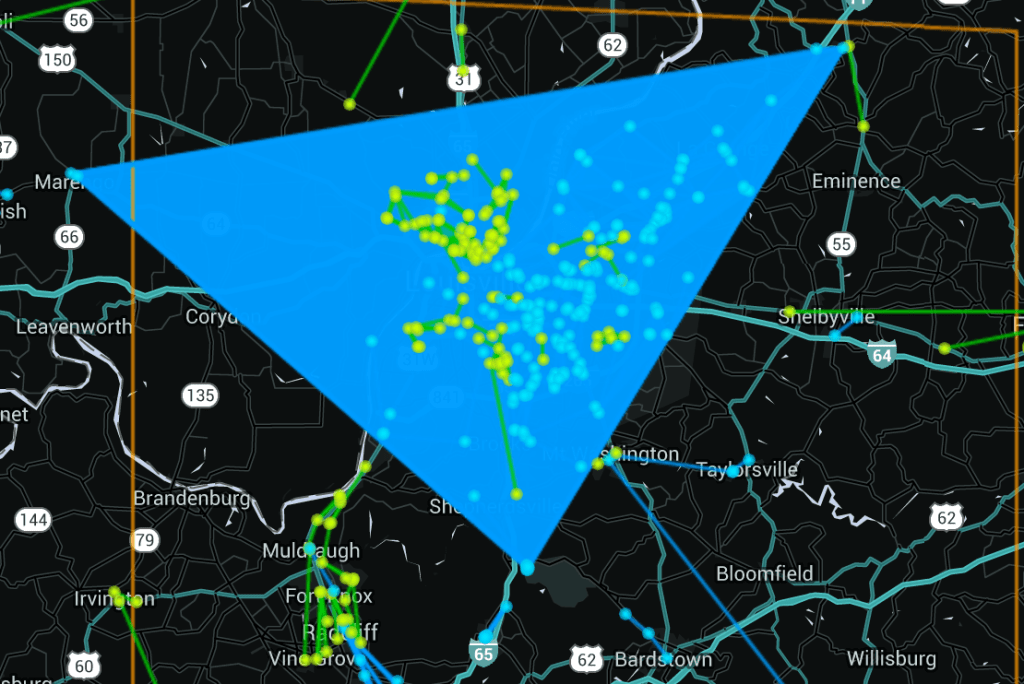
Well done, agents. —
-
I’ve posted enough videos on this blog that you all know how nutso I am. I speak fast and look around a lot. I mumble, stutter, and ramble all at once. Coherency is the antithesis of my extemporaneous speaking style.
So that’s why I over prepared this time. For a fifteen minute talk, I spent over 8 hours defining my idea, creating effective slides (with GIFs!) and adding notes to the presenter tools of those slides. I did a dry run with someone whom I trust. I asked myself questions people might ask and iterated time and again to make my unclear moments more clear. Most importantly, I slowed the hell down.
It still wasn’t perfect, but I survived a bout of public speaking in front of a group of peers. Peers whom I hold in the highest regards. And they actually took that time from their (very busy) day to listen to me yak on for a bit. It was thrilling.
Over prepare. It’s so worth it.
—
-
It’s fair to say I underestimated the difficulty of writing campaigns for my Dungeons and Dragons group. Going through a pre-written module was simple enough and it provided a good outline for the sort of information I’d need. Having DM’d that adventure with success, I thought I knew enough about the game to prepare a good story.
Having blogged everyday for 17 weeks straight, I figured I also knew how to write consistently. Inching forward bit by bit in hopes of making something bigger seemed like a habit I already formed.
Between knowing DnD and having a writing habit, I was totally prepared. Boy was I wrong.
Writing in short-form blog posts and publishing them for that quick endorphin rush is so much easier than writing for a long-form project. Sure, it’s still writing a small amount everyday – but making all that little work fit into the puzzle of a larger arc? Ugh, it’s beyond frustrating.
Every little bit that I add to the story is some of the hardest writing I’ve ever done. I sit there tensing up over why I can’t find a way to connect one scene to another. I write up non-player characters, dungeon crawls, and antagonist monologues all to delete them minutes later. Each session is a workout in my mind.

Manticore, a monster our players fought in a recent game And you couldn’t pay me to stop. Writing for these games has brought how I think of storytelling to a new level. It’s made me appreciate my reading more too. Most importantly, it makes me proud to present my work to my friends at each game. Working through a module, I was playing ‘not to screw it up,’ and now I’m playing to make what’s in my head come to life.
Bit by bit, my writing will get better.
—
-
The Domino Project was a publishing experiment run by Seth Godin and Amazon.com back in 2011. They released several small books aimed at business readers. The book equivalent of a TED talk, they could be consumed quickly (about an hour) and had a mission of spreading ideas quickly. Occasionally Seth still publishes blog posts for Domino, but they haven’t released a book in some time.
I mention it because I first heard of Steven Pressfield by reading Do the Work, a book he wrote for the Domino Project. Do the Work was really a lite version of The War of Art and I bought the Kindle edition of The War of Art shortly thereafter. In fact, they were so similar I never really went through The War of Art in its entirety. It sat in my Kindle account for 4 years being less than appreciated.

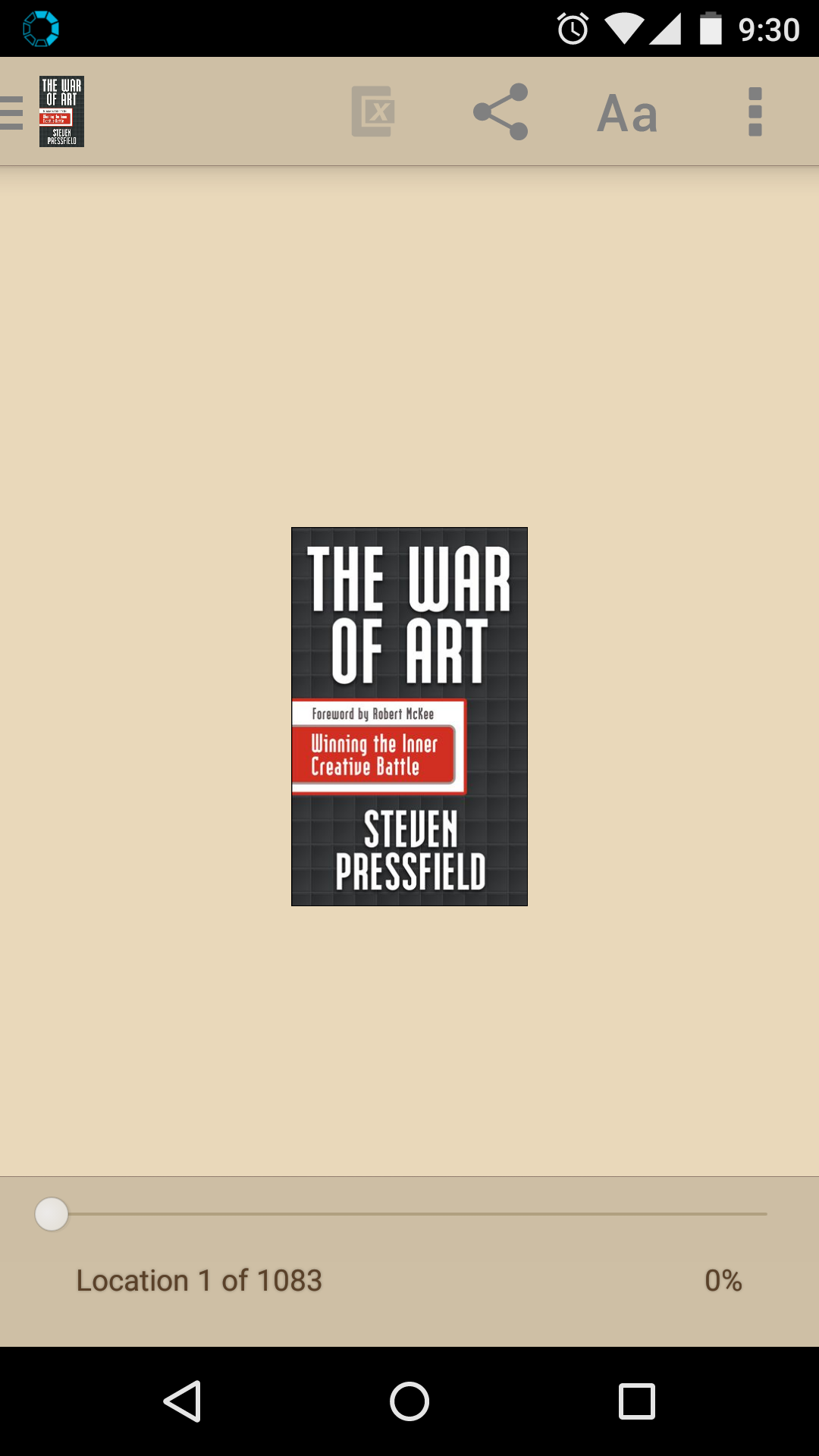
The cover as seen on my Kindle App on my phone. When I bought this it was for my Kindle 3G, which has since died. It reads like a suite of blog posts categorized under “Resistance,” and “Turning Pro.” Pressfield is adamant that resistance is the reason your best work isn’t moving from your brain to the paper. Like spiritual warfare, the demons of resistance exist physically and promise you a better life if you’ll procrastinate, overanalyze, and fear doing your work.
His cure is to recognize the Resistance as a tangible force so that you don’t let it claim you. You can treat it as antagonist to your life’s story instead of a part of your own being. By separating yourself from the Resistance, you can defeat it. And you can keep it on the run by Turning Pro. He doesn’t mean professional like being a doctor or lawyer, rather he means not being an amateur.
The amateur plays for fun. The professional plays for keeps. To the amateur, the game is his avocation. To the pro it’s his vocation. The amateur plays part-time, the professional full-time. The amateur is a weekend warrior. The professional is there seven days a week.
Pressfield, Steven (2010-10-11). The War Of Art: Winning the Inner Creative Battle (p. 62). FastPencil PREMIERE. Kindle Edition.
Most importantly, the amateur falls to their Resistance. The professional does whatever takes to beat it.
The book is timely for me. I’ve written about my battles with procrastination before and I’m now planning a workshop for colleagues that falls right in line with defeating resistance. Between that connection to the material and Pressfield’s direct writing style, I excitedly finished this book in 3 days. It took longer to write this post.
Do yourself a favor and read the book. More importantly do yourself a favor and put in a few professional hours to that work you’ve been delaying. Steven would agree, I think.
The War of Art by Steven Pressfield
Amazon ; Goodreads ; Wikipedia
—
-
Everytime I finish a day on my c25k app, it prompts me with this hashtag-filled social media garbage. Thusfar I’ve been able to deny its desire to clog all your Twitter and Facebook feeds – but you better believe I’m gonna let it share on the last run. You’re not a runner if you don’t tweet about it, after all.

#everymomentcounts —
-
Ber is watching The Silence of the Lambs while I finish up some work.
—
-
Slowly but surely, I’ve been forcing Ber into the world of Star Trek. It was easy for her to enjoy the tv episodes of Next Generation and Deep Space Nine, but the movies from the Next Generation crew are so bad it’s amazing she hasn’t changed the WiFi password on me. For the longest time Netflix never had Insurrection, so the viewing had been halted. But once it got added to their library we watched it and tonight we concluded the era with Nemesis.
It’s a wholly ridiculous movie and you probably shouldn’t watch it. But here’s a deleted scene that just cracks me up:
You’re my boy, Wil.
—
-
In addition to festivities at San Diego Comic Con proper, Geek & Sundry, Nerdist, and Smart Girls hosted a ‘Conival’ at Petco Park last weekend. I’m still catching up on all the videos, but I definitely enjoyed the Titansgrave panel from that event. One quote from Wil really stood out after a fan asked if Titansgrave could ever have a live stream episode:
I was watching Critical Role before we went into editing on Titansgrave. And I thought, “there is no way we’re gonna be as good as Critical Role. There is no way we can live up to this.” […] We just had to do something that was very different from Critical Role.-Wil Wheaton (at 51:20)
You might recall I’ve made that contrast as well.
Watch the whole panel discussion here:
—
-
You might recall that I’m doing the Couch-to-5k (c25k) running program. I’ve completed the first four weeks of the program and in terms of habit-forming it’s been one of the easier ones I’ve attempted in my life. I piggy-backed on my habit of walking the dog around sun-down by turning that into my warmup walk.
But my real secret? I hack portals while I run.
A mere mortal would be content with only the c25k app of their choice running on their phone, telling them when to walk and when to jog. But why stop there when you could collect the XM, get an evening hack to help your Sojourner badge, and maybe do a mission? Not to mention that running is the fastest way to earn kilometers on your Trekker badge.
I’m out of missions near my house that I can complete during a 30 minute c25k session, but I still always fire one up. So long as I keep my fingers off the lock button, the mission will keep my scanner up and running so I can hack any nearby portals. And you better believe I don’t run anywhere without portals.
One of the appeals of Ingress is that it provides a game that gets you moving. It’s a lot easier to walk two more blocks when there’s a portal over there. If you apply the same idea to running, it’s a lot easier to take on that next jog when you know you’ll have fun. Out of breath fun, but still fun.



 Alex "Gus" Gustafson