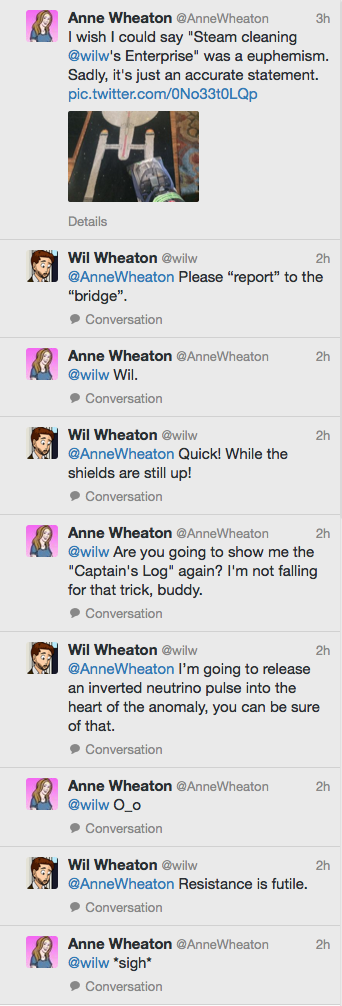
• Amber and I have crushes on Anne and Wil Wheaton respectively. She likes to say that we’re ‘like Team Wheaton but less famous.’

    With that in mind, here’s a recent online conversation between the two:

    team-wheaton-on-twitter

    via Yes, we were on opposite ends of the house. | WIL WHEATON dot NET.

  • Back in May, the blog Decode Ingress had a guest post called “Golro’s Guide to Glyphing” outlining more about glyph hacking than I’ve ever seen one explain. There’s really nothing inaccurate in that article, but there is a lot of stuff that probably doesn’t deserve discussion with most people. Golro’s not wrong that finger friction is a factor — but I really don’t need to read your ‘fingernail’ recommendation. I’m gonna do what feels best for me and that’s all there is to it.

    So I decided to write my own no-nonsense guide to glyph hacking. These tips will help you if you want to improve your glyph hacking accuracy and are willing to spend an extra 10 minutes a day outside of your normal Ingress time. That might be because you’re hunting the Translator Badge. Or maybe you just farm a lot and want to make the most of your time. Your motivations are your own, but here’s a ‘real person’ take on this Ingress mini game.

    translator-badge-silver

    Learn the Glyph Names

    Most everyone starts out by providing their own little names for the glyphs. “Destiny” might get remembered as “dragon,” or “hide” instead is ‘boat.’ This works up to a point, but there are many glyphs that will tend to get looked over as ‘squiggly,’ ‘dash,’ or ‘around-the-bottom.’ In the thick of a farming session, your brain cannot mess with these half-measures.

    The fastest way to learn the Glyph names that I’ve found is with the tool Memrise. I first heard of Memrise when Tim Ferriss did a memory contest with it, but my parents told me they were using it to learn the shaper glyphs. Click here to find the Shaper Glyphs course, and once you’re signed up you can play the memrise game on the web, or with their mobile app. It’s just hard to find this course on the mobile app.

    I zoomed through this course as I was comfortable with about 2/3 of the glyphs already. But even if you don’t zoom through it, these will help put in place the proper name for each and every glyph. No more than 5 minutes a day needed on Memrise, in my opinion.

    Practice the Glyphs

    Knowing the glyph names is half the battle. Practicing the motions is also important. I’ve screwed up just as many glyph hacks from missing dot as I have from not knowing the glyph name. And now that I know all the glyph names, missing dots is my most common reason! Immediately after my 5 minute memrise session, I’d do 5 minutes on Glypher. This app will simulate as many glyph hacks as you can stand, with no need to walk from portal to portal in between. Really great for nailing down the motions.

    If you need to check on real names you haven’t yet seen in Memrise, Glypher will let you draw the glyph and identify its name too.

    Speak the Glyph Names

    Once you know some of the glyph names, start saying them out loud while you read the glyphs in the real world. If you don’t know a glyph name when it pops up. Try to avoid the temptation of adding a ‘fake’ name in its place. You’re going to finish all the glyphs in a matter of weeks at the longest, so accept your best guess for now. Later you’ll be hitting all the glyphs almost every time.

    Glyph a Level, Any Level

    Unless I desperately need gear, I only glyph hack on level 7 and 8 portals now. I do this because all portals of the same level tend to cycle through the same phrases. I know all the glyphs — but some are more common than others at the same portal level, so why risk coming up on a less common one just because it gets used in L4 portal phrases? I don’t need the L4 power cubes that badly.

    I recommend you do the same. If you can handle 5 glyphs, glyph only level 8s and maybe level 7s. But if you can only handle 3, stay with the L5 portals but glyph every L5 portal you reach. You’ll see the common phrases over and over again and you’ll find they get easier.
  • American game designer Jason Rohrer appeared on the Wisconsin Public Radio show To the Best of Our Knowledge discussing his two-player, strategy (and gambling) game, Cordial Minuet.

    I’m not too interested in this game personally, but I do think Jason really knows his games. The interview is really great.

    Listen to “Gambling with 100% Skill” at ttbook.org 

  • At the WordPress Louisville meetup this week I heard about a new tool, Engagely.

    We were doing a bit of show and tell and one site had a member signup form and included a Captcha. The room groaned, as you’d expect. No matter how useful they may be, people hate figuring out those warped letters and numbers.

    A couple folks immediately recommended Engagely as a substitute. This is a new piece of software developed by a team of students at University of Louisville. They recently won a top prize of $30,000 in the Kentucky Cabinet for Economic Development’s Idea State U Business Plan Competition.

    According to their website, “Engagely can tell if your website’s visitors are human—without any scrambled letters.” To good to be true? I hope not. None of my current projects require member signup, but if I come up on one that does I’ll use Engagely for it and let you know more. If you test it out first, let me know in the comments.


    getengagely.com
    Find them on Twitter @getengagely

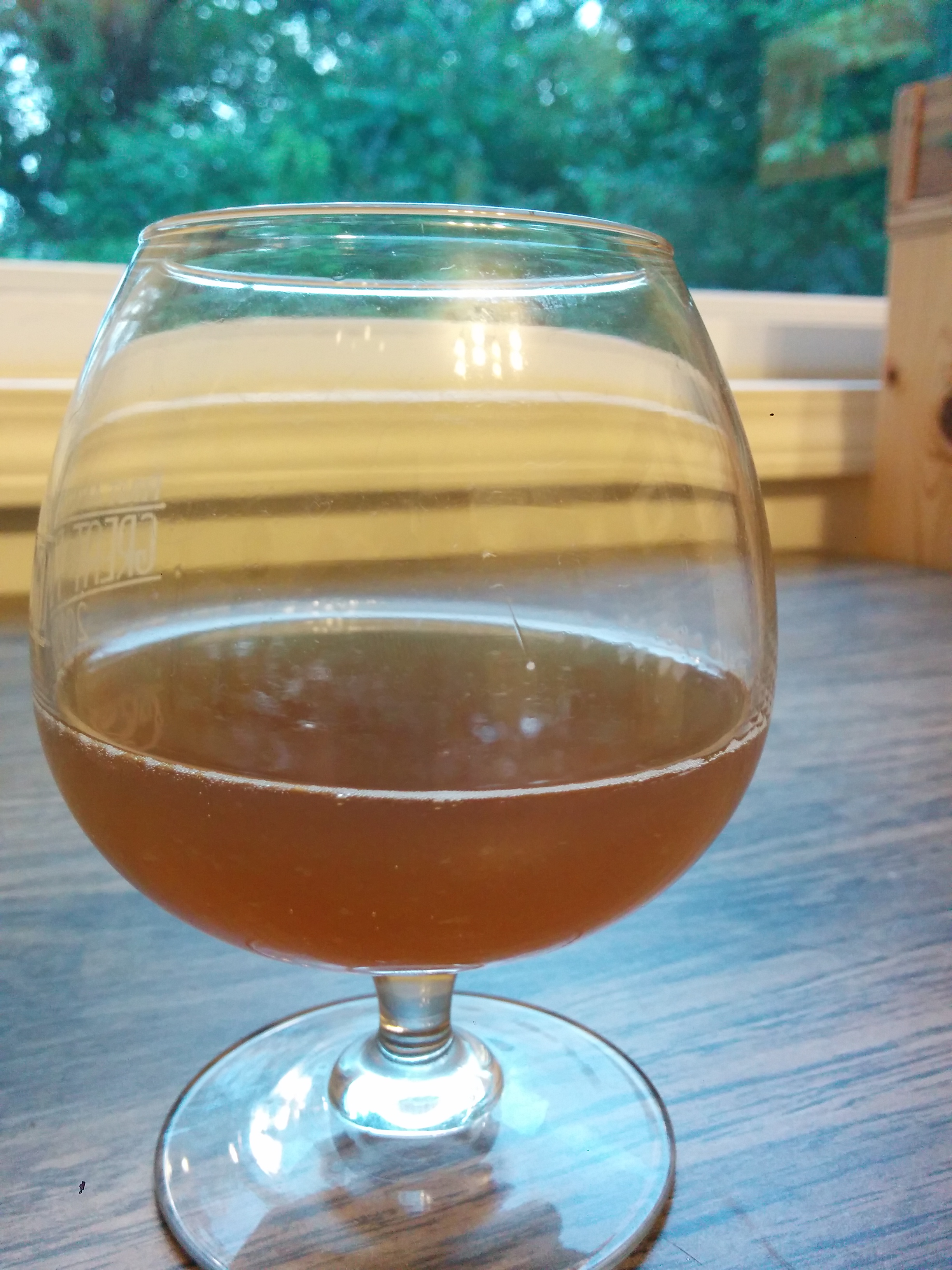
  • Ber and I made a braggot earlier this year. It’s been carbonating and bottle conditioning in our basement for two months now and I decided that it was time to sample.

    Just enough bubbles
    Just enough bubbles

    It was absolutely delicious. I think we nailed the carbonation and it has a great mouthfeel. It rides the line between beer and wine just like we wanted. The only thing I want to change on the next batch is to lessen the amount of orange peel. The orange flavors are nice, but started to dominate the taste when we intended it to be more of a ‘hint of orange.’ Live and learn. 🙂

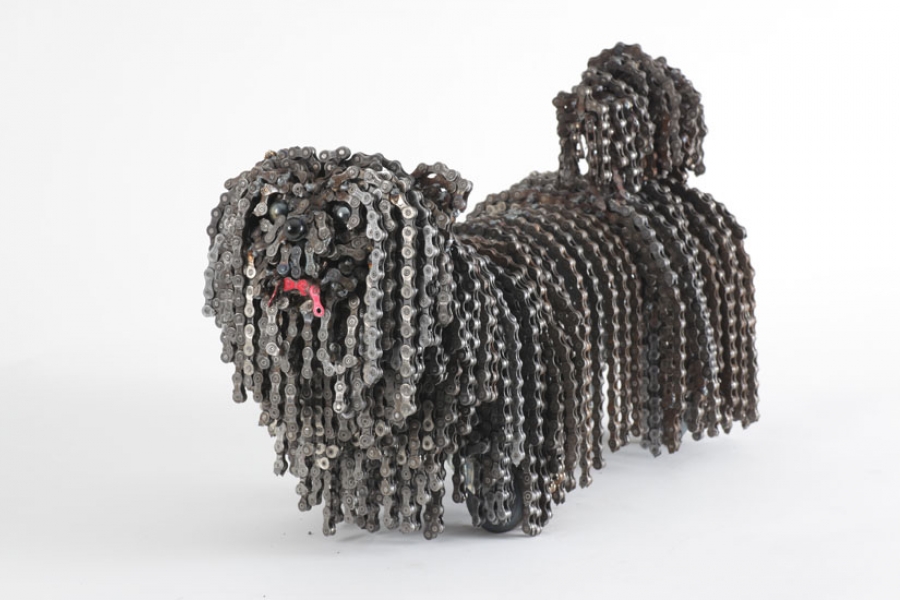
  • On twitter last night, someone shared this image of a dog made out of bicycle parts.

    Dog sculpture from Nirit Levav
    Dog sculpture from Nirit Levav

    I turned to Ber and said, “It’s that dog breed! With the dreads! Shenzi?!”

    “You mean a Puli?” she replied. She of course was right. Shenzi was one of the hyenas from the Lion King. Except today I found out this dog sculpture is actually a Pekingese.

    Clearly I don’t see enough dogs.

  • A defining moment of my life thusfar has been discovering this book, A Guide to the Good Life: The Ancient Art of Stoic Joy by William B. Irvine.

    The discovery of this changed a lot of my thinking, because up to that point I had been confused as to my life’s goal. Religion and its purpose of service to God was important to my youth, but this really drifted away in college. I found some role models who were clearly  Christian Hedonists (in hindsight) and I drifted away from them too.

    Starting to think for myself, I found the swedish idea of ‘lagom‘ and began to think my life was really the pursuit of moderation, or balance. But this seemed to be more helpful as a mechanic, or detail, not really fulfilling as a life’s goal. Reading Irvine’s book, I learned that the stoic sage pursues virtue above all else. Seneca teaches that ‘virtue is sufficient for happiness’ and the sage, full of virtue, then feels no misfortune.

    Penelope, bronze by Emile-Antoine Bourdelle
    Penelope, bronze by Emile-Antoine Bourdelle

    By no means am I a stoic sage. More and more I think no ever has been or will be. But this pursuit of virtue has certainly treated me well. Feeling less anger helps me soothe the anger in others. The act of negative visualization helps me focus on important priorities and resolve grief. Desiring less helps you save more.

    The difficulties I face most are when the pursuit of virtue turns into fits of guilt. My terrible habits of procrastination feed this even more. When I fail in a daily exercise, I often feel like I fail in my entire philosophy of life. But these feelings are temporary, and they help you continue with greater strength in the future.

    Most importantly, this pursuit has shaped my philosophy of life. How I think I should handle a given day, problem, or question is no longer vaguely determined but is instead set against a set of principles I truly believe. I’ve chosen to believe in principles that make the world better and myself a better person in it.

  • My friend Will, the same guy who recommended Hyperion and The Fall of Hyperion to me, told me to read Old Man’s War at about the same time. I had read the Amazon Kindle sample of Red Shirts a while back, and seen Scalzi on the Forbidden Island episode of Tabletop, but that’s all I really knew about the guy. I should’ve known that a friend of Wil Wheaton’s is a friend of mine.

    This book barely left my hands. Every chapter left me wanting more and I kept telling Ber, “I freakin’ love this book,” every time I reluctantly set it down. The writing resonated with me and the plot was perfectly laid out. It had me making guesses and gasping at the real resolutions.

    Science fiction often involves of bit of speculation into future technology. Old Man’s War provides this through well contextualized dialogue, instead of forcing the read through narrative ‘rules’ of its universe. It helps that almost every character we meet is going through a phase of exploration, so we learn what they learn. If we don’t understand it’s okay, because they don’t understand it either. We probably ‘don’t have the math for it’ anyway. 😉

    The novel also involves quite of a bit of war-time combat which normally isn’t my thing. But I didn’t find myself skimming through the descriptions at all in this book. A big factor in this was that every battle was also involved new techniques of fighting and different strategies. Aliens don’t fight the same way every battle like human armies do. In particular, a scene with ritualist one-on-one combat during a diplomatic session had me holding my breath. So, so good.

    A great book and a great blog from the same author
    A great book and a great blog from the same author

    When I was reading the book, I was looking up stuff about John. He recently scored a major deal with his publisher, and this quote from a New York Times article seemed appropriate to my discovery of this talented author:

    Patrick Nielsen Hayden, the executive editor for Tor, said the decision was an easy one. While Mr. Scalzi has never had a “No. 1 best seller,” he said, “he backlists like crazy.”

    “One of the reactions of people reading a John Scalzi novel is that people go out and buy all the other Scalzi novels,” Mr. Nielsen Hayden said.

    And that’s about right. I’ve already added this series’ sequel, The Ghost Brigades, to the last spot on my 2015 reading list and reserved it from my local library. Any books I don’t really get into on my list will quickly be replaced by another Scalzi novel.

    Icing on the cake? Scalzi uses WordPress.com. Read his blog at whatever.scalzi.com.

    Mr. Scalzi, you’ve won yourself a fan.


    Old Man’s War by John Scalzi

    Amazon ; Goodreads ; Wikipedia

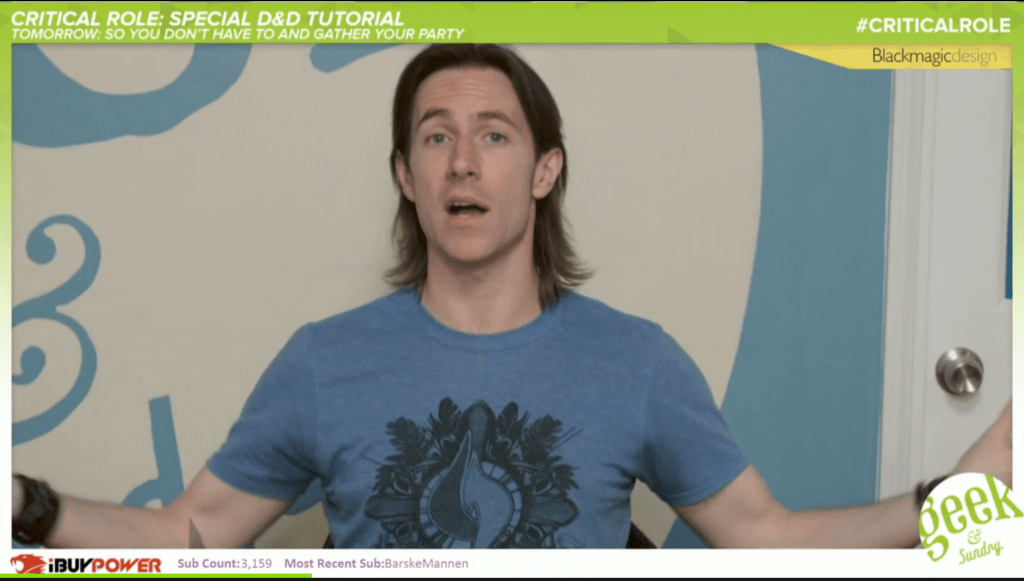
  • While preparing for my first romp at Dungeon Mastering, a resource I really appreciated was Episode 12 of Critical Role from Geek and Sundry’s twitch channel.

    Matt Mercer has been DMing this same group of performers (most of them are voice actors, which makes the characters really awesome) for a long time. Critical Role is normally the group’s weekly DnD game, but episode 12 are tips and tricks on how to run your own game and get new characters started. The DMing advice really starts at 42 minutes in and lasts about an hour, but you can see the whole video here:

    Critical_Role__Episode_12_–_Dungeons___Dragons_Campaign_Tips___Geek_and_Sundry

  • Love Ben Folds, and this new song is seriously the direction I wish all pop music would go in. Before now I’d never heard of yMusic, but I plan to seek them out. 🙂

    Listen to “Capable of Anything” by Ben Folds and yMusic | NPR’s All Songs Considered